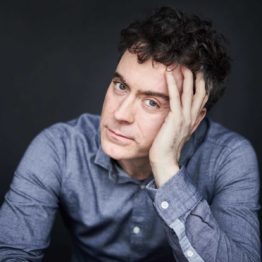
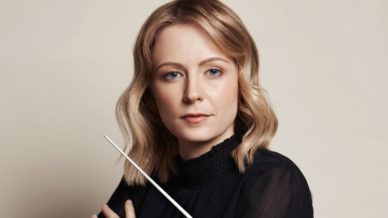
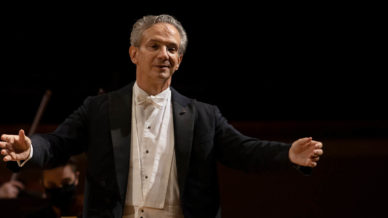
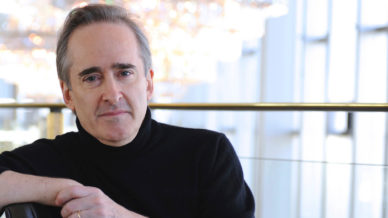
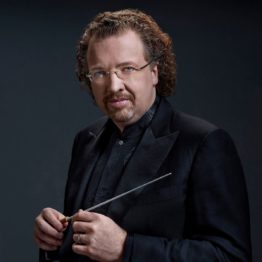
JUANJO MENA conducts
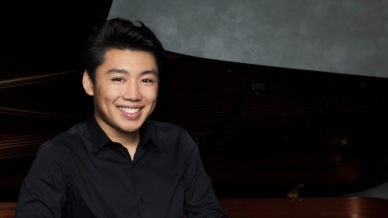
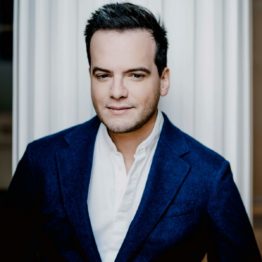
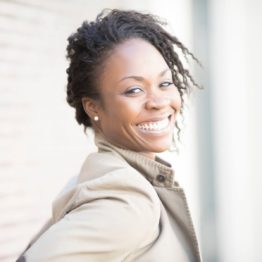
JAVIER PERIANES piano

HAYDN Symphony No. 44 in E minor (“Trauer-Symphonie”)
RAVEL Concerto in G major for Piano and Orchestra
GINASTERA Variaciones Concertantes
DEBUSSY “Ibéria”, No. 2 from Images

Two of Spain’s most beloved exports – distinguished conductor Juanjo Mena and pianist Javier Perianes – take the stage to celebrate Spanish and Latin contributions to classical music. Haydn’s highly dramatic “Trauer Symphony” opens the program followed by Ravel’s Concerto in G with jazz and Basque folk music influences. Then, Alberto Ginastera, one of the most innovative Latin composers of the 20th century, amplifies the voice of Argentinian folk music in Variaciones Concertantes. Followed by Debussy’s “Ibéria” which clearly invokes the Spanish fascination that became so popular in late 19th century France.

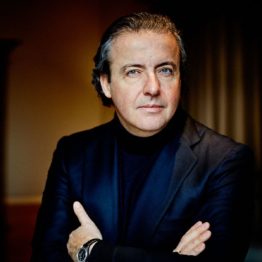
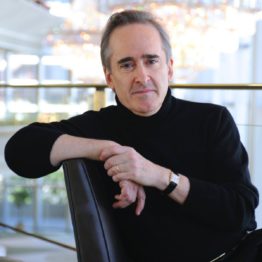
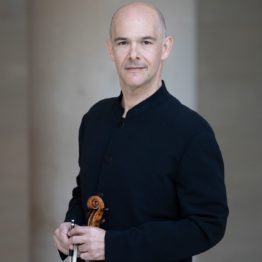
Juanjo Mena

Juanjo Mena

Conductor

Read More

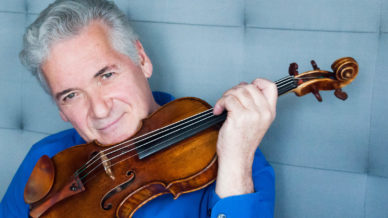
Javier Perianes

Piano

Read More

Program Notes

by René Spencer Saller

The son of a wheelwright and a cook, Haydn distinguished himself early as a boy
soprano, endowed with a savant’s musical memory. He sang with the world-class
choir of St. Stephen’s Cathedral in Vienna until 1749, when his voice changed and
forced him into a new career. For the next few years, he cobbled together a living as
a part-time teacher and freelance musician, sometimes even busking in the streets
for strangers’ spare coins.

At age 25 his luck changed, after he was hired by the Bohemian nobleman and music
patron Count Morzin. During the three or so years that Haydn served as the count’s
music director and court composer, he finished his first 15 symphonies as well as an
impressive array of chamber music, serenades, and divertissements.

In 1761 Haydn, who had recently married, accepted a job offer from Prince Paul
Anton Esterházy. Although the Prince died the following year, Haydn got along even
better with his brother and successor, Nicolaus, who immediately endeared himself
by proposing a higher salary. Haydn would work for the Esterházy court for nearly
three decades, during which time he produced a staggering amount of music: 50
quartets; 45 keyboard sonatas; a sizeable assortment of Italian operas and
singspiels for the marionette theater that the family maintained; and, because the
Prince played the baryton, a stringed, fretted instrument that resembles the viola
d’amore, at least 126 baryton trios.

Haydn also composed some 80 symphonies, maturing as an orchestrator and finding
new ways to whet his wild imagination. The E minor Symphony is one of seven
minor key symphonies that he wrote between 1767 and 1773. By 1771 or so,
around the time of its composition (the precise date of which is unknown), he had
developed a compositional style that was later (anachronistically) called Sturm und
Drang (Storm and Stress), after a literary movement that emerged in the late 19th
century. Labels and categories notwithstanding, Haydn’s brilliantly executed, proto-
Romantic approach valued originality, vigor, and passion over elegance, balance,
and restraint, the hallmarks of Classical music, at least as conventionally
understood.

The nickname for Symphony No. 44, “Trauer” (“Mourning”), refers to a popular but
unsubstantiated account in which Haydn was said to have requested that the third
movement of the symphony be played at his memorial service. At any rate, the
Adagio was not on the program for Haydn’s eventual funeral, which took place more
than 30 years after the premiere of Symphony No. 44. But the symphony as a whole
was performed soon after Haydn’s death, at a commemorative concert in Berlin,
and, perhaps for that reason, the “Trauer” nickname stuck.

A Closer Listen
The first of the four movements of “Trauer” is fierce, propulsive, full of contrasts.
Marked Allegro con brio, it is set in the home key of E minor. Although the
movement follows sonata form and other Classical conventions, it makes some
daring forays into dissonance, especially in its rigorously contrapuntal conclusion.

The second movement, marked Allegretto, is a minuet, in E minor, and a trio, in E
Major. Although the minuet-and-trio form is a standard feature of the Classical
symphony, it usually occupies the third movement, not the second. Here Haydn
experiments with the “Canone in diapason” procedure, guiding us on twisty
pathways between the melody and bass line. In the minuet portion, the violins and
first oboe introduce the theme, and the second oboe, violas, and horns take it up at
the octave. The central trio ascends to the radiant parallel mode of E Major, before
the minuet returns, restoring the minor mode.

Thanks to its tempo and instrumentation—muted strings, murmuring oboes, and
somber horns—the overall mood of the Adagio is serene and spacious. Despite the
symphony’s nickname, the slow movement isn’t at all funereal: you won’t hear a
trace of a funeral march or a Requiem reference. It’s set in E Major, like the
preceding trio, and so surpassingly beautiful in places—listen for the entrance of the
oboes and horns—that it ranks among Haydn’s most affecting masterpieces. More
than mourning, this Adagio brings solace: it’s a balm, not a sermon.

The dramatic finale, marked Presto alla breve, is urgent and relentless. Based on a
unison theme, the closing movement explores the outer limits of counterpoint,
culminating in a ferocious double canon. Haydn closes in E minor, the home key,
instead of the expected parallel major.

Between 1929 and 1931, Ravel worked simultaneously on two remarkable—and
remarkably different—piano concertos. One is dark and intense, written for the left
hand. Paul Wittgenstein, the Austrian pianist who commissioned it, lost his right
arm in World War I. The other (two-handed) concerto, in G Major, is sprightly and
energetic. Ravel, a gifted pianist, had intended it as a concert showpiece for himself.
Unfortunately, by the time it was finished, he was ailing and no longer had the
necessary stamina. He asked the pianist Marguerite Long to give the premiere,
which he conducted on January 14, 1932.

In 1931, as he was putting the finishing touches on the Piano Concerto in G, he
explained that it was “written very much in the same spirit as [concertos by] Mozart
and Saint-Saëns.” “The music of a concerto should be lighthearted and brilliant, and
not aim at profundity or at dramatic effects,” he continued. “It has been said of
certain classics that their concertos were written not ‘for’ but ‘against’ the piano. I
heartily agree. I had intended to title this concerto ‘Divertissement.’ Then it
occurred to me that there was no need to do so because the title ‘Concerto’ should
be sufficiently clear.”

A Closer Listen
Despite its unusual features, the work is structured like a conventional Classical
concerto, in three contrasting movements. In the hectic and humorous introduction,
the piano traces delicate arpeggios while piccolo and trumpet interject saucy
retorts. A sultry clarinet evokes Gershwin’s Rhapsody in Blue, while the piano
contributes jerky syncopated rhythms. After a magical harp-drenched interlude, the
brash jazz themes return.

The lustrous Adagio assai, the concerto’s Mozartian center, isn’t nearly as simple as
it sounds. As the pianist Long wrote, “I told Ravel one day how anxious I was, after
all the fantasy and brilliant orchestration of the first part, to be able to maintain the
cantabile of the melody on the piano alone during such a long, slow, flowing
phrase…. ‘That flowing phrase!’ Ravel cried. ‘How I worked over it bar by bar! It
nearly killed me!”

The finale is brief but complex, peppered with key changes and unusual orchestral
textures, particularly from the trombone and bassoon. Spirited percussive flourishes
recall the opening movement, and the concerto ends with a joyful bang.

Born in Buenos Aires to a Spanish father and an Italian mother, Ginastera (he
pronounced it the Catalan way: JEE-na-STAIR-uh) began his conservatory training at
age 12. In 1942 he won a Guggenheim Foundation grant, which he used a few years
later to study with Aaron Copland in the United States.

Idealistic and outspoken, Ginastera made many political enemies in his native
Argentina. In 1952, a year before he wrote Variaciones concertantes, he lost his
position at Argentina’s foremost music conservatory, Conservatorio de Música y
Arte Escénico in La Plata, which he had founded and directed since 1948. He
offended the Peróns by refusing to rename the conservatory after Eva, the
president’s powerful wife. Deprived of his academic post (at least until Juan Perón
was deposed in a military coup), Ginastera made ends meet by scoring films and
accepting random commissions. He spent the last dozen years of his life in Geneva,
Switzerland.

A meticulous craftsman, Ginastera tended to destroy any efforts that he deemed
unsatisfactory—and he was seldom satisfied. What passed through his filter was
pure gold. Although he left only 54 numbered opuses, most remain in the active
repertoire.

Nationalism and Its Discontents
Late in life, Ginastera categorized his works into three general periods, which he
identified as follows: objective nationalist (1934–1948), subjective nationalist
(1948–1958) and neo-expressionist (1958–1983). He wrote Variaciones
concertantes in 1953, at the midpoint of his middle period. Unlike his earlier music,
which often quoted from the folk tunes and dances of his homeland, in Variaciones
concertantes all the “nationalist” signifiers are implied, not explicit. “This work has a
subjective Argentinean character,” the composer explained. “Instead of employing
folklore material, an Argentinean atmosphere is obtained by the use of original
melodies and rhythms.”

Ginastera’s Variaciones concertantes was a commission from the Asociación Amigos
de la Música in Buenos Aires. The orchestra of that organization, conducted by Igor
Markevitch, gave the premiere on June 2, 1953. The work consists of two
instrumental interludes (the first for strings, the second for winds), which serve as
musical bookends for eight distinct and colorful variations.

A Closer Listen
Nearly every instrument in the orchestra gets its turn in the spotlight. Ginastera
assigns a different solo instrument, pairing, or group to each of the variations, which
range in length from fleeting to substantial. Right away, in the slow and searing
introduction, the harp and cello state the theme, which incorporates one of the
composer’s stylistic trademarks: the notes E–A–D–G–B–E. These are, not
coincidentally, the same pitches played on the open strings of a guitar in standard
tuning.

After this murkily fecund strings interlude, the variations unfurl. The first, titled
“Variazione giocosa” (Humorous Variation), is a frisky, flute-dominated caper, with
scampering pizzicato strings. In the equally antic but somewhat edgier “Variazione
in modo di Scherzo” (Variation in the Style of a Scherzo), the clarinet instigates the
orchestral high jinks.

In the “Variazione drammatica” (Dramatic Variation), the viola sings a piercingly
emotive cadenza, attended by winds and low strings. The longest of the variations,
it’s a haunting exploration of modal harmony. Bassoon and oboe are in the forefront
for the “Variazione canonica” (Canonical Variation), a questing and contemplative
take on the theme. Trumpet and trombone carry the short but memorable
“Variazione ritmica” (Rhythmic Variation). In the “Variazione in modo di moto
perpetuo” (Variation in the Perpetual-Motion Mode), brass, winds, and timpani
precede the violin’s turn in the soloist’s spot, another cadential movement that
infuses virtuosic technique with folk-fueled pyrotechnics. Next, in the “Variazione
pastorale” (Pastoral Variation), a lyrical and soulful French horn riffs on the theme
until it almost resembles a hunting call reimagined by Chet Baker.

After an interlude for winds, the double-bass, lightly bolstered by spare harp
arpeggios, reprises the main theme, as presented in the introduction. The zany final
variation, “Variazione in modo di rondo” (Variation in the Rondo Mode), is a
nonstop endorphin rush, replete with hand-strummed chords, boldly syncopated
percussion, and jazzy Gershwinesque vamps. In addition to the rondo, an ancient
dance form alternating a refrain and contrasting episodes, Ginastera drew from the
malambo tradition to create this variation, which uses repeated notes to imitate the
tapping, stomping, brushing feet of the dancing gauchos. Malambo, which one
scholar described as “a battle between men who stomp in turn to music,” retains its
cultural cachet. The National Malambo Festival is held every year in the Cordoba
Province of Argentina.

“Iberia” is the second of three cyclical works—collectively titled Images pour
Orchestre—that Debussy composed between 1905 and 1912. The set was initially
planned for two pianos, but Debussy decided that it required a richer palette
containing bolder and more diverse colors. With Images, he explained, “I’m trying to
write something else—realities, in a manner of speaking—what imbeciles call
‘impressionism,’ a term employed with the utmost inaccuracy, especially by art
critics, who use it as a label to stick on Turner, the finest creator of mystery in the
whole of art!”

Sketches of Spain
A triptych within a triptych, “Iberia” is a three-part portrait of Spain. It features a
slower, more meditative middle movement surrounded by romping, celebratory
outer movements. Although “Iberia” abounds with Moorish-inflected melodies and
Latin-inspired rhythms, Debussy’s lived experience of the country was minimal: he
spent a single afternoon in San Sebastian, attending a bullfight, and returned home
to France before nightfall. According to the Spanish composer Manuel de Falla,
Debussy’s sole excursion to Spain, brief though it was, left him with a vivid
impression of “the light in the bullring, particularly the violent contrast between the
one half of the ring flooded with sunlight and the other half deep in shade.”

A Closer Listen
The lively, light-splashed opening movement, “Par les rues et par les chemins”
(Through Streets and Lanes), combines tart dissonances, stomping rhythms, and
sparkling melodic digressions. Next, the mesmerizing nocturne “Les parfums de la
nuit” (The Fragrances of the Night) traces the elusive contours of a dream: blurry
harmonies, sinuous tempos, distant bells. Finally, “Le Matin d’un jour de fête”
(Morning of a Feast-Day) brims over with giddy revelry. “It sounds like music that
has not been written down,” Debussy observed. “There is a watermelon vendor and
children whistling—I see them all clearly!”
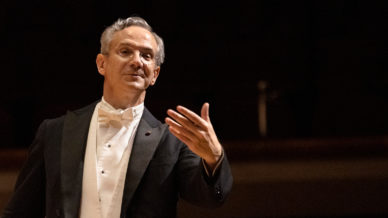
FABIO LUISI conducts
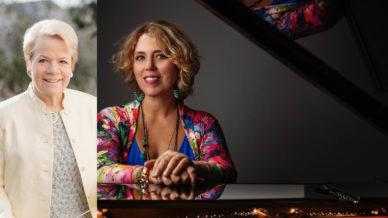
LISE DE LA SALLE piano

JULIA PERRY Study for Orchestra
CLARA SCHUMANN Piano Concerto
LOUISE FARRENC Symphony No. 3

Leading into our Women in Classical Music Symposium, we invite you to explore the work of three female composers who dared to make a difference in the world of classical music. The lesser-known, but no less deserving, Julia Perry and the great Clara Schumann and Louise Farrenc were highly educated and internationally trained musicians. These talented women helped pave the way for female artists, like our soloist Lise de la Salle, whose playing inspired the Washington Post to write, “For much of the concert, the audience had to remember to breathe… the exhilaration didn’t let up for a second until her hands came off the keyboard.”

An African-American composer and conductor born in Kentucky, Julia Perry studied at Westminster Choir College and then Juilliard. Many of her early works are vocal, often incorporating influences from black spirituals. But she also studied with Luigi Dallapiccola at Tanglewood and in Italy, and she also worked with Nadia Boulanger, winning the Boulanger Grand Prix for her Viola Sonata. Her catalog includes a dozen symphonies and a pair of piano concertos; her theater works include three operas and a ballet, several on her own librettos or scenarios.

Most of this is sadly neglected, but her Short Piece for Orchestra (also known as Study for Orchestra, 1952) was recorded in a live performance by the New York Phil- harmonic under William Steinberg in 1965. It is an initially raucous, highly energized essay, brilliantly scored. There are edgy lyrical contrasts, however, and the work closes in a haunted Lento, before a whip- lash ending returns the aggressive opening thunder. — John Henken

Clara Schumann embarked on her Piano Concerto in A minor, Op. 7, not only at a pivotal moment in her own musical development, having previously focused on ‘small forms’ (Kallberg, 1992), but also in the history of the genre. To write a piano concerto in the 1830s was to engage with an established tradition that was in a state of change. Significant in this regard were the continued advancements in the modern piano, the expansion of form, evolving relationships between the soloist and the orchestra, and shifting attitudes towards virtuosity, all of which gave rise to new ways of navigating the nineteenth-century piano concerto.

Louise Farrenc (1804–1875) studied under Anton Reicha and worked in Paris for decades as a respected composer, pianist and music scholar. In 1842 she was the first woman to be appointed to the position of professor for piano at the Conservatoire National, a position she held for 30 years.

Juanjo Mena

Juanjo Mena

Conductor

Read More

Javier Perianes

Piano

Read More

Program Notes

by René Spencer Saller

Even after suffering a debilitating stroke in 1971, Julia Perry persisted in composing,
building up a substantial body of work, in numerous genres. Her catalogue contains
more than a dozen symphonies and at least three operas, all of high quality. But if
you don’t recognize her name, please know that this has nothing to do with her
talent, which was formidable, and everything to do with her status, or lack thereof,
as a Black woman in the mid-20th-century United States. Until recently, Perry, like
the two other female composers presented in this concert, has been woefully
neglected on concert programs. During her own lifetime, racism and sexism
challenged but never deterred her; if anything, she worked harder to chart her own
path. Her revelatory compositions deserve—and reward—our attention.

Perry, the fourth of five sisters, was born in Lexington, Kentucky, to a schoolteacher
mother and a physician father, who once played piano well enough to accompany
the celebrated lyric tenor Roland Hayes in concert. The family moved to Akron,
Ohio, when Perry was 10. She earned a scholarship to Westminster Choir College, in
Princeton, New Jersey, where she studied voice, piano, and composition, and then
Juilliard, which led to her first Guggenheim Fellowship.

In 1948 Perry earned her master’s degree and presented her secular cantata
Chicago, a setting of a 1914 Carl Sandburg poem. She went on to study with the
influential teacher Luigi Dallapiccolla, at Tanglewood and, in Fontainebleau, outside
of Paris, with the legendary Mlle. Nadia Boulanger, who taught everyone from Aaron
Copland to Astor Piazzolla.

In 1952 Perry won the Boulanger Grand Prix for her Viola Sonata. She also won a
second Guggenheim Fellowship, which allowed her to study with Dallapiccolla again
in Italy. The premiere of her Study for Orchestra was a high point of her second stint
in Italy. With the vocal composition Stabat mater, Study for Orchestra would become
one of her most-performed works and one of the few pieces from her catalogue to
be recorded during her lifetime. During the summers of 1956 and ’57, she studied
conducting in Siena and directed a series of concerts in Europe for the Information
Service of the U.S. State Department.

Perry wrote her final five symphonies while contending with serious health
conditions and a long hospitalization. These include her Symphony No. 11 (“Space
Symphony”), Symphony No. 12 (“Simple Symphony”), and the Marching Band
Symphony. She also wrote an opera about the Salem witch trials, Symplegades. Her
last known composition was Bicentennial Reflections, from 1977, a concise
meditation on the theme of American freedom for tenor, electric bass, and chamber
ensemble. On April 24, 1979, in Akron, Ohio, Perry experienced catastrophic heart
failure and died at age 55.

A Closer Listen
Perry wrote Study for Orchestra in 1952, during her second Italian sabbatical.
Sometimes called by its earlier name, Short Piece for Orchestra, the seven-or-so-
minute orchestral work is distinctively American, a bewitching concoction of the
European neoclassical tradition that Perry soaked up in the conservatories and the
richly syncopated African American musical vernacular, the bonded-by-blood
spirituals, gospel hymns, and jazz ballads that anchored her like family. In 1964, a
dozen years after its premiere, the New York Philharmonic performed and recorded
Perry’s Study for Orchestra during a European tour. Vividly scored, the piece
contrasts a hypnotic Lento passage with aggressive outer sections.

On January 13, 1833, the 13-year-old German piano prodigy Clara Wieck wrote in
her diary that she had begun to compose her first piano concerto. All she had
composed so far was a single movement, which she called a “concert rondo.” It
would eventually serve as the final movement of her Piano Concerto in A Minor.
“[Robert] Schumann will orchestrate it now so that I can play it at my concert,” she
noted, referring to her father’s piano pupil and boarder—and her own future
husband. Clara had been an international sensation before hitting puberty, and
Robert, despite being nine years older, was still struggling to make a name for
himself as a composer and critic.

More than anyone, even more than he believed in himself, Clara believed in Robert’s
genius. Even though he wouldn’t kiss her until her 16th birthday party, and he was
sporadically involved with other women, he had fallen for her, and the feeling was
mutual. (As she wrote in a letter to him, “When you gave me that kiss, I thought I
would faint.”) Unfortunately, her controlling (and, at least by contemporary
standards, abusive) father opposed the match and even filed a lawsuit to prevent it.

After a long and rocky courtship, conducted mostly by secret correspondence, Clara
and Robert eventually prevailed in court. They married on September 12, 1840, the
day before she turned 21: she called it “the most beautiful and the most important”
day of her life. Over the next 16 years, until Robert’s premature death in 1856, she
barely had time to practice on the family’s only piano, much less compose. She gave
birth to eight children, seven of whom survived infancy; supported her increasingly
delusional husband creatively, emotionally, and financially; supervised the servants
and balanced the household budget; and, despite Robert’s pathetic objections,
maintained a busy performance schedule.

After Robert died in a sanitarium, in 1856, Clara composed very little. As a touring
concert pianist, she devoted much of her life to promoting her late husband’s music
and ensuring his place in the canon. By the mid-19th century, concert culture no
longer demanded that virtuoso performers also write or improvise their own
material, as had been the case during her adolescence, when she wrote her Piano
Concerto in A Minor primarily for her own performance. Without the weight of
expectation, she felt less motivated to compose. Instead, she resolved to serve as
Robert’s loyal champion and a (probably) platonic muse to their younger friend and
frequent houseguest, Johannes Brahms.

Perhaps relevantly, before her father obtained sole custody of her after divorcing
her pianist mother, before he transformed the child into a world-famous prodigy,
she reportedly spent the first four years of her life deaf and mute.

The A Minor Concerto
At age 15, Schumann, then Wieck, posed for a portrait with one hand resting on the
keyboard, the sheet music for her own Piano Concerto in A Minor, Op. 7, within
reach: a sweet-faced, sad-eyed girl whose public image was carefully constructed by
her Svengali father.

She wrote her sole Piano Concerto between the ages of 13 and 15; she debuted it
publicly on November 11, 1835, at the Leipzig Gewandhaus, under the baton of her
friend and admirer Felix Mendelssohn. This premiere took place a couple of months
or so after her fateful 16th birthday party. In those days, piano prodigies were
expected to demonstrate mastery of harmony and counterpoint by performing their
own compositions or improvisations at recitals. As Anna Beer explains in her
essential Sounds and Sweet Airs: The Forgotten Women of Classical Music: “Because
Clara Wieck was a child prodigy on the piano, she became a child-prodigy composer
for the piano.”

Robert’s growing attention fortified her ego while weakening her father’s hold.
When she was only 12, he praised her as a composer, treating her as his creative
equal: “Have you been composing a lot?” he asked in his first surviving letter to her,
dated January 11, 1832: “And if so, what? Sometimes I hear music in my dreams—
what a composer you are!” She began dedicating compositions to him, including her
sublime Romance variée for piano, Op. 3 (1831–33).

Disappointingly, Robert commissioned and published a somewhat tepid-to-critical
review of her Piano Concerto for the journal he edited at the time. His future fiancée
was incensed not only because he didn’t review it himself but also because he must
have approved this unsympathetic review of a concerto that he had helped
orchestrate.

Defending herself, she reminded him that her audiences, which spanned the
continent, insisted on hearing immediate encores of her original material: “Of the
many pieces I played, my concerto was received the best…. Do you think I am so
unaware that I don’t know the faults of the concerto?” [But] there is no better
feeling than having satisfied an entire audience.”

A sharp but well-deserved dig: as they both were all too aware, Robert wasn’t nearly
as adept as his teenage fiancée when it came to satisfying audiences. Proving the
point, she took the concerto on tour for the next few years, presenting it some seven
times across the continent, including at one recital in Vienna, when audiences
demanded two encores of the finale.

Ignorant critics made backhanded compliments and sexist assumptions. As one
anonymous reviewer quoted by Beer opined: “If the name of the female composer
were not on the title one would never think it were written by a woman.” Another
critic attributed the composer’s bold harmonic choices to a woman’s “moody”
nature, adding that innovation often promotes deviance in “the daughters of Eve.”

A Closer Listen
Despite the composer’s youth, the Piano Concerto in A Minor is both accomplished
and daring. Her through-composed melodies, unusual key changes, and risky
modulations exude a Chopinesque perfume, never mind that Wieck began writing it
before Chopin’s piano concertos were widely known. On the other hand, it’s likely
that Clara, a precocious connoisseur who made her professional debut at the Leipzig
Gewandhaus at age 11, had heard Chopin’s music performed during her extensive
European concert tours.

There are no true pauses between movements: in what would become a Romantic
convention, if that’s not a contradiction in terms, each movement flows into the
next, linked by carefully considered segues.

Cast in A minor, the opening Allegro maestoso announces itself with a grand tutti
before interjecting a contrasting idea, a plangent wind refrain. The piano tosses out
some resolute scales before the orchestra returns. After a dramatic cascade of
downward arpeggios, the soloist plunges upward and launches into the first solo
cadenza, a delicately voluptuous, polonaise-like tune that soon sweet-talks the
strings into humming along. Overall, the movement is punctuated by dynamic shifts
and climactic crescendos and decrescendos.

Preceded by another segue, also labeled Romanze, the central Romanze, in the
distant key of A-flat major, eases into a rapturous stretto piano interlude, a dreamy,
druggy waltz. Call it a rhapsody in deep violet, call it what you will, but it blossoms
into a twilit colloquy with the cello, one of the most indelible duets in the repertoire.
And even if she is biting Chopin’s steez (debatable), who cares? Who can fuss about
influence while marinating in bliss? Does it matter that Chopin himself admired
Clara’s music?

For the Allegro non troppo finale, which is almost as long as the first two
movements combined, Schumann returns to the home key of A minor, decorating
the majestic polonaise idea with ornately virtuosic filigree. At once fierce and
tender, the finale represents the soloist’s—originally the composer’s—spotlight
moment. It is the only one of the three movements that was originally orchestrated
by Robert, although Clara likely revised it in the years afterwards, after numerous
live performances. The orchestra offers support and occasional friction, alternating
full-throated tutti sections with subtle, chamber-like accompaniment that sets off
the sparkling piano pyrotechnics.

Born Jeanne-Louise Dumont, in Paris, Louise Farrenc was the daughter and sister of
prominent sculptors. She grew up in a creative, mildly bohemian environment and
thrived, starting piano lessons as a young girl, under Cecile Soria, a pupil of Muzio
Clementi. Soon she was learning from such luminaries as Ignaz Moscheles and
Johann Nepomuk Hummel. She became a touring piano virtuosa a good decade
before Clara Schumann debuted at the Leipzig Gewandhaus. In 1819, at age 15, she
studied composition privately with Anton Reicha, an associate of Beethoven’s and
an esteemed faculty member at the Paris Conservatoire. Whether the young woman
ever took classes with Reicha at the Conservatoire remains unknown, but it seems
unlikely, since the composition coursework was limited to men at the time. Female
students could not enroll, at least officially, in any composition class at the
Conservatoire until 1870.

In 1821 Dumont married Aristide Farrenc, a flutist and music publisher 10 years her
senior. It proved a good match for her, giving her the freedom to pursue the kind of
music career that was usually off limits to women of her social class. The couple also
co-founded a leading publishing house, Editions Farrenc. In 1826 the Farrencs
welcomed a daughter, Victorine, who, like her mother, enjoyed a successful career
as a concert pianist.

In 1842 Farrenc was named a tenured professor of piano at the Paris Conservatoire,
a prestigious position that she would hold for the next 30 years. Underpaid for the
first decade of her employment, she demanded and received a salary equal to that of
her male colleagues after her 1849 nonet for strings and winds wowed critics and
audiences alike. Twice, in 1861 and 1869, she won the Prix Chartier of the Académie
des Beaux-Arts. She was praised by the likes of Hector Berlioz and Robert
Schumann.

Along with chamber music and works for solo piano, Farrenc wrote three
symphonies. She completed her Symphony No. 3 in G Minor, Op. 36, in 1847, and
debuted it two years later, at the Société des Concerts du Conservatoire, on the same
program as Beethoven’s Fifth Symphony.

Farrenc stopped composing in 1859, after her 33-year-old daughter, Victorine,
succumbed to a long illness. Despite her grief, she stayed busy, continuing to teach
at the Conservatoire until 1873 while also researching French Baroque keyboard
music for the 23-volume scholarly series that she was compiling and editing with
Aristide.

A Closer Listen
The first movement, a dramatic, richly textured Allegro, opens with a solitary oboe,
which spins out a theme that the strings caress and adapt before conjuring up a
ferocious coda. In the slow movement, a solo clarinet croons over velvety strings,
low brass, and muted timpani. The effervescent scherzo amps up the contrast, and a
satisfying woodwind-centered trio ensues before the final emphatic chords of the
finale, a contrapuntal delight.

FABIO LUISI conducts
NICOLA BENEDETTI violin

JAMES MACMILLAN Violin Concerto No. 2 | U.S. Premiere
BRUCKNER Symphony No. 4

Benedetti’s innate musicianship and spirited presence makes her one of the most sought-after violinists today, coupled with the pre-eminent Scottish composer of his generation, James MacMillan’s music combines rhythmic excitement, raw emotional power and spiritual meditation. The Guardian described MacMillan as, “…a composer so confident of his own musical language that he makes it instantly communicative to his listeners.”

The piece pairs perfectly with Bruckner Symphony No. 4, an ethereal journey that is romantic, luscious and deeply spiritual. Join Fabio Luisi and the DSO as they bring the “Romantic” tale hidden in its music to life.


Dallas Symphony Young Professionals Logo

Our Dallas Symphony Young Professionals will be in attendance to this performance. Learn more about how to become involved in DSO YP here!


DSO AFTER DARK WITH THE CONCERT TRUCK
NOV 18 | 9:30 PM | HALL ARTS HOTEL

Please join us after the concert for a free, outdoor performance featuring members of the DSO and pianists Nick Luby and Susan Zhang. Hors d’oeuvres, cider, and drinks will be served.


Juanjo Mena

Juanjo Mena

Conductor

Read More

Javier Perianes

Piano

Read More

Program Notes

by René Spencer Saller

The Scottish composer and conductor Sir James Loy MacMillan first attracted
international attention in 1990, after the rapturous response at the BBC Proms to
his large symphonic work The Confession of Isobel Gowdie. Subsequent successes
range from his extraordinary (and unusually popular) percussion concerto Veni,
Veni, Emmanuel to his Fourth Symphony, which was first performed on August 3,
2015, by the BBC Scottish Symphony Orchestra and conducted by his fellow
countryman Donald Runnicles. MacMillan’s recording with Britten Sinfonia of his
Oboe Concerto, for the Harmonia Mundi label, won the 2016 BBC Music
Magazine Award. In 2019 The Guardian deemed his Stabat Mater the 23rd greatest
work of art music since 2000.

MacMillan completed his Violin Concerto No. 2 in 2021, and the world premiere—
performed by the work’s dedicatee, the Scottish virtuoso Nicola Benedetti—took
place on September 28, 2022, at Perth Concert Hall, Perth, Australia. This is its U.S.
premiere.

The Composer Speaks
My Second Violin Concerto is written in one through-composed movement and is
scored for a medium-sized orchestra. It opens with three chords, and the notes
which the soloist plays in these (pizzicato) outline a simple theme which is the core
ingredient for much of the music. This three-note theme incorporates a couple of
wide intervals which provide much of the expressive shape to a lot of the
subsequent melodic development throughout the concerto.

When the soloist eventually plays with the bow, the character of the material sets
the mood for much of the free-flowing, yearning quality of the music throughout.
The prevailing slow pulse is punctuated by some faster transitional ideas, and after
a metric modulation the second main idea is established on brass and timpani,
marked alla marcia. The wide-intervallic leaps in the solo violin part continue to
dominate in a passage marked soaring, even as the music becomes more rhythmic
and dancelike.

An obsessive repetitiveness enters the soloist’s material just before the first main
climax of the work, where the wind blare out the wide-intervalled theme. The
central section of the work is reflective, restrained and melancholic, where the
soloist’s part is marked dolce, desolato and eventually misterioso, hovering over an
unsettled, low shimmering in the cellos and basses.

The martial music returns and paves the way for an energetic section based on a
series of duets which the violin soloist has with a procession of different
instruments in the orchestra—double bass, cello, bassoon, horn, viola, clarinet,
trumpet, oboe, flute, and violin. After this we hear the three notes/chords again
developed in the wind over a pulsating timpani beat, which sets up the final climax
marked braying, intense and feroce.

The final recapitulation of the original material provides a soft cushion and
backdrop to the soloist’s closing melodic material, marked cantabile, before the
work ends quietly and serenely.

My Second Violin Concerto is dedicated to Nicola Benedetti and in memoriam
Krzysztof Penderecki, the great Polish composer who died in 2020. —Sir James
MacMillan, 2022

Trained by his schoolmaster father and the Augustinian monks of St. Florian, the
Austrian composer Anton Bruckner worked as a cathedral organist for 13 years,
earning a strong regional reputation for his virtuosic playing and brilliant
improvisations. A late bloomer, he didn’t enter his maturity as a composer until
midlife. Bruckner’s Fourth Symphony was his first major composition to earn
acclaim almost from its debut.

The Hissing and Laughing Multitude
The enthusiastic response to his revised Fourth came as a huge relief to its 57-year-
old author at the 1881 premiere. Four years earlier, his Third Symphony, which was
inscribed with an unctuous dedication to Richard Wagner, went nightmarishly awry
at its Vienna premiere. Bruckner, an anxious and inexperienced conductor, was
leading—or attempting to lead—openly hostile musicians who seemed determined
to humiliate him. Before he even lifted his baton, he was losing audience members;
each successive movement sent more patrons scuttling out of the concert hall. As his
publisher Theodor Rättig later recalled, “the applause of a handful of some 10 or 20
generally very young people was countered by the hissing and laughing multitude….
When the audience had fled the hall and the players had left the platform, the little
group of pupils and admirers stood around the grieving composer, attempting to
console him, but all he could say was, ‘Oh, leave me alone; people want nothing to do
with me.’”

Bruckner revised the “Wagner” Symphony at least six times, an exacting and time-
consuming process to which he subjected all nine of his symphonies save the last,
whose finale he left unfinished when he died, a little over a month after he turned
72.

As Bruckner’s first real success (and his last popular triumph until the
groundbreaking Seventh Symphony), the Fourth brought much-needed validation—
perhaps even vindication. He would work it over numerous times, sketching out a
fanciful “Romantic” program only to disavow most of the extramusical content just a
few years later. Despite many attempts (some of them likely unsanctioned
“corrections” by ambitious disciples and associates), Bruckner never improved on
the 1878–1880 version of the Fourth Symphony, which is performed for this
concert.

Paradox and Perfection
For most of his life, Bruckner was badly underestimated. His worldly Viennese
contemporaries ridiculed him as a pious dolt, a rural church organist with no
redeeming cleverness. But despite his unfashionable accent and gauche manners,
Bruckner was no country bumpkin. His music, which reflects his dual roles as
church organist and composer of symphonies, revels in paradox: it’s massive and
nuanced, dense and subtle, ancient and modern. Intricate polyphony is draped in
sumptuous Wagnerian orchestration. An expansive tone poem morphs into an
elaborate fugue. Before our very ears, musical forms adapt and evolve in a state of
transcendent flux.

There’s nothing simple about Bruckner’s Fourth, including its date of completion.
For Bruckner, a self-doubting perfectionist, no composition was ever truly finished.
All told, there are approximately three dozen different versions of Bruckner’s nine
symphonies. Maybe these multiple versions exist not because the composer was
indecisive but rather because he saw his music as mutable, subject to change over
time. Musicologists argue about the authenticity of various editions of Bruckner’s
nine symphonies and speak of “the Bruckner Problem” —shorthand for the vexed
debates about authorial intention and the relative virtues and drawbacks of the
various revisions. Some editions include “corrections” that Bruckner never saw,
much less sanctioned; other editions reflect changes that he made because he was
insecure and possibly too receptive to suggestions from others.

Bruckner composed the first version of his Symphony No. 4 in E-flat major between
January and November 1874, but that original iteration was never performed or
published during his lifetime. He continued to tinker with his Fourth Symphony,
along with most of the others, for another 14 years. Bruckner researchers have
identified at least seven authentic versions and revisions of the Fourth Symphony.
For this concert the 1878–1880 version (ed. Nowak), which is the version of
the Fourth most commonly performed and recorded today, was selected.
Bruckner scored the Fourth for one pair each of flutes, oboes, clarinets, and
bassoons, with four horns, three trumpets, three trombones, timpani, and strings.
Starting with the 1878 revision, a single bass tuba is included in the
instrumentation.

Romantic Revisions
The nickname Romantic was used by Bruckner, who also created, and eventually
abandoned, a program for the symphony. Bruckner marked the autograph of the
Scherzo and Finale of the 1878 version of the symphony with brief descriptions
such as Jagdthema (hunting theme), Tanzweise während der Mahlzeit auf der Jagd
(dance tune during the lunch break while hunting), and Volksfest (people’s festival).

Also for this revision, Bruckner replaced the original scherzo with a new movement
that’s commonly known as the “Hunt” Scherzo (Jagd-Scherzo). The new movement,
Bruckner explained in a letter, “represents the hunt, whereas the Trio (Tanzweise
während…) is a dance melody which is played to the hunters during their meal.” In
1880 Bruckner replaced the Volksfest finale with a new one based on an earlier
melodic idea.

After one especially productive rehearsal of the Fourth, Bruckner gave the
conductor, Hans Richter, a coin and urged him to buy himself a beer to celebrate.
(Richter was charmed by the gesture and kept the money as a keepsake.) On
February 20, 1881, Richter presided over the first performance, in Vienna. It was the
first premiere of a Bruckner symphony not to be conducted by Bruckner himself,
and it was also his first unqualified success. After years of enduring hisses and
insults, the composer finally heard real applause and basked in the unfamiliar
warmth. To his delight and astonishment, he was summoned for a bow after each
movement.

The Composer Speaks
In a letter to the conductor Hermann Levi dated December 8, 1884, Bruckner
supplied a vivid, if abbreviated, program: “In the first movement, after a full night’s
sleep, the day is announced by the horn, 2nd movement song, 3rd movement
hunting trio, musical entertainment of the hunters in the wood.”

Six years later, in another letter, he expanded on the program somewhat: “In the
first movement of the ‘Romantic’ Fourth Symphony the intention is to depict the
horn that proclaims the day from the town hall! Then life goes on; in the
Gesangsperiode [the second motif] the theme is the song of the great tit [a bird]
Zizipe. 2nd movement: song, prayer, serenade. 3rd: hunt, and in the Trio how a
barrel-organ plays during the midday meal in the forest.”

Yet when asked years later to elaborate on the meaning of the finale, Bruckner
confessed, “I’ve quite forgotten what image I had in mind.”

Bruckner and Wagner
At the age of 41, when he attended the Munich premiere of Tristan und Isolde,
Bruckner became a committed Wagnerian. In 1873 he made his first pilgrimage to
Bayreuth, uninvited and barely tolerated, so that he could show his idol the score to
his Third Symphony, dedicated “in deepest veneration to the honorable Herr
Richard Wagner, the unattainable, world-famous, and exalted Master of Poetry and
Music, by Anton Bruckner.” Upon meeting his hero, Bruckner allegedly fell to the
ground, yelping, “Master, I worship you!” Despite or because of his strenuous
enthusiasm, he made a dismal impression on his hosts. In her diary, Wagner’s wife,
Cosima, speaks disparagingly of the visitor as “the poor Viennese organist.”

In summer 1876, Bruckner made his second trip to Bayreuth, where he attended the
first complete performance of Wagner’s Ring cycle. He was so profoundly affected
by the experience that he immediately began major revisions of several earlier
works, including his Fourth Symphony.

A Closer Listen
Bruckner’s 1878–80 revision of the Fourth has the following tempo markings and
key signatures:

Bewegt, nicht zu schnell (With motion, not too fast), in the home key of E-flat major
Andante, quasi allegretto, in C minor

Scherzo. Bewegt (with motion)—Trio: Nicht zu schnell (Not too fast), in B-flat major

Finale: Bewegt, doch nicht zu schnell (With motion, but not too fast), in E-flat major

JAMES CONLON conducts
ALEXANDER KERR violin

SHOSTAKOVICH Festive Overture
KORNGOLD Concerto for Violin and Orchestra in D Major
SHOSTAKOVICH Symphony No. 5 in D minor

This concert includes three magnificent works by composers seeking redemption.

Korngold wrote his lyrical and cinematic Violin Concerto, which embraced both his Viennese upbringing and his full-blooded romantic style as the defining composer of Hollywood’s Golden Age. Concertmaster Alexander Kerr (Michael L. Rosenberg Chair) will be the soloist.

Written in just three days at the behest of a conductor of the Bolshoi Theater Orchestra, who due to mysterious political maneuverings and bureaucratic snafus needed a new work to celebrate the October Revolution, and the concert was in three days. Shostakovich’s friend, Lev Lebedinsky, sat down next to him and began to compose. Lebedinsky relates:

“The speed with which he wrote was truly astounding. Moreover, when he wrote light music he was able to talk, make jokes and compose simultaneously, like the legendary Mozart. He laughed and chuckled, and in the meanwhile work was under way and the music was being written down.”

During the reign of Stalin, Shostakovich spent much of his time playing cat-and-mouse games with the culture police; always trying to push his artistic boundaries outwards without offending Stalin by seeming too formalist.
Shostakovich the composer has taken a lot of flack from Western musicologists for seeming to capitulate to the whims of Stalin and his henchmen. At the time, criticism was life threatening, not merely career threatening, which explains why Shostakovich withheld his exploratory Fourth Symphony (being performed later in the season) and composed instead the Fifth to please the regime.

It is interesting to consider how Shostakovich might have perceived the place of the artist in the Stalinist order of things when he relates:

“An artist whose portrait did not resemble the leader disappeared forever. So did the writer who used ‘crude words.’ No one entered into aesthetic discussions with them or asked them to explain themselves. Someone came for them at night. That’s all. These were not isolated cases, not exceptions. You must understand that.”

“It didn’t matter how the audience reacted to your work or if the critics liked it. All that had no meaning in the final analysis. There was only one question of life or death: how did the leader like your Op.? I stress: life or death, because we are talking about life or death here, literally, not figuratively. That’s what you must understand.”


“…Conlon has fully assumed the mantle of the most accomplished music director currently on the podium of an American opera house.”

Opera News

James Conlon, Conductor

James Conlon

Conductor

Read More
Alexander Kerr_Concertmaster_Violin I_Michael L Rosenberg Chair_Dallas Symphony

Alexander Kerr

Concertmaster

Michael L. Rosenberg Chair

Read More

Program Notes

by René Spencer Saller

Dmitri Shostakovich spent most of his career falling in and out of political favor with Joseph Stalin and the Soviet functionaries who did his bidding. One year the culture cops would be in raptures over his music, lavishing accolades, awards, and even, on one occasion, a country home on the composer; the next year, they would berate him for “decadent formalism” and other perceived crimes against Socialist Realism and deprive him of the opportunity to perform, publish, or record.

As if that weren’t punishment enough, Shostakovich had reason to fear for his life. He kept a packed suitcase by the door and often slept in the outer foyer to reduce the risk to his family in the event of a late-night raid. He wasn’t being paranoid. Countless friends and colleagues had disappeared in the dead of night to be executed or detained in penal camps, all for seemingly minor, even unintentional infractions.

But by 1954, when Shostakovich wrote his Festive Overture, his main nemesis was dead, and he could relax somewhat. (Stalin died on March 5, 1953, the same day as Shostakovich’s fellow composer and countryman Sergei Prokofiev, also branded a decadent formalist.) Several commentators have suggested that the jubilant mood of the overture reflects Shostakovich’s joy over the dictator’s death, but this remains speculation.

What we do know comes courtesy of Shostakovich’s friend Lev Lebedinsky, who was visiting the composer at his home one autumn day in 1954, when Vassili Nebolsin, a conductor from the Bolshoi Theater Orchestra, showed up at his door with an urgent commission: The company needed a new work to commemorate the 37th anniversary of the October Revolution—for a concert that would take place in three (!) days.

Shostakovich rose to the challenge. Working swiftly and cheerfully, he managed to meet his impossible deadline. Before an hour had elapsed, he was handing over pages of the score to Nebolsin’s couriers, who conveyed them, ink barely dry, to the Bolshoi copyists entrusted with preparing the orchestral parts for performance.

“The speed with which he wrote was truly astounding,” Lebedinsky recounted. “Moreover, when he wrote light music he was able to talk, make jokes, and compose simultaneously, like the legendary Mozart. He laughed and chuckled, and in the meanwhile work was under way and the music was being written down.”

Shostakovich conducted a professional orchestra only once in his life, in 1962, at a concert devoted to his own music that was organized by the conductor and virtuosic cellist Mstislav Rostropovich, a good friend. To open the program, Shostakovich selected his Festive Overture. Five years after his death, the piece became internationally famous as the signature theme of the 1980 Summer Olympics in Moscow.

 A Closer Listen

Lebedinsky, who attended the dress rehearsals, described the Festive Overture as “this brilliant, effervescent work, with its vivacious energy spilling over like uncorked champagne.” Shostakovich, for his part, used more prosaic language: “just a short work, festive or celebratory in spirit.”

The six-minute piece begins with a brass fanfare, which the composer borrowed from a song that he had originally written to mark his daughter Galina’s ninth birthday. (Eight years after his death, the birthday composition was appended to his Children’s Notebook, Op. 69, although he never considered it part of that cycle himself.) The clarinets announce a frisky motif, which is taken up by the other winds. The horns respond with a secondary theme—stately and ceremonial enough to provide contrast but not so serious as to seem ponderous. Throughout Shostakovich supplies electrifying rhythms, unexpected harmonies, pizzicato strings, and blindingly fast melodic runs. After the reprise of the fanfare motif, a propulsive coda brings the Festive Overture to an incendiary close.

The son of a prominent Viennese music critic, Erich Wolfgang Korngold ranks among the greatest child prodigies in music history. His first ballet was professionally staged when he was only 13. By the time his opera Die tote Stadt received simultaneous premieres in Hamburg and Cologne, the 23-year-old was one of the most famous composers in Europe. But then disaster struck. His latest opera could not even be performed in Vienna because of the Anschluss, the annexation of Austria by Nazi Germany in 1938. As Korngold drily observed, “We thought of ourselves as Viennese; Hitler made us Jewish.”

Over the next seven years, the Nazis would murder an estimated six million Jews across German-occupied Europe, approximately two thirds of the European Jewish population. Given the brutal realities of the Holocaust, it’s no exaggeration to say that Korngold’s side job as a film composer likely saved his life. To make extra money, he had been collaborating with the director and impresario Max Reinhardt, another Viennese Jew. Reinhardt had hired Korngold to adapt the score of Mendelssohn’s incidental music for A Midsummer Night’s Dream, both stage and film versions. In 1938, after accepting a fortuitously timed commission to write the music for The Adventures of Robin Hood, Korngold moved to Hollywood for good; five years later, he became a U.S. citizen.

All told, he composed 18 original scores for feature films. Several were nominated for Academy Awards, and two won. Korngold chose to devote his final years to concert music, but he never regarded his film scores as inferior. “Never have I differentiated between my music for the films and that for the operas and concert pieces,” he maintained. “Just as I do for the operatic stage, I try to give the motion pictures dramatically melodious music, sonic development, and variation of the themes.”

From Triumph to Flop to Triumph

Korngold composed most of the material for his first and only violin concerto between 1937 and 1939, revising the work substantially in 1945, the year of its completion. He began the sketches with Bronislaw Huberman in mind for the solo part, but as the aging virtuoso’s technical skills began to deteriorate, Korngold consulted other violinists, including the one he eventually chose, his neighbor, Jascha Heifetz.

Beyond agreeing to debut it, Heifetz helped Korngold perfect the score, ensuring that the violin writing struck the right balance between lyricism and virtuosity. Korngold compared these two aspects of his concerto to the opera singer Enrico Caruso, known for his romantic intensity, and the legendary violin virtuoso and composer Niccolò Paganini, the epitome of the supernaturally endowed showman.

“In spite of the demand for virtuosity in the finale,” Korngold wrote, “the work with its many melodic and lyric episodes was contemplated more for a Caruso than for a Paganini. It is needless to say how delighted I am to have my concerto performed by Caruso and Paganini in one person: Jascha Heifetz.”

Korngold dedicated the concerto to Alma Mahler-Werfel, the widow of his early supporter and mentor Gustav Mahler.

On February 15, 1947, Vladimir Golschmann led the virtuoso Jascha Heifetz and the St. Louis Symphony Orchestra in the wildly successful premiere of Korngold’s Violin Concerto. The audience waxed ecstatic, giving the musicians what was, according to some accounts, the longest standing ovation ever recorded for any concerto performed by that orchestra. Korngold described his joy in a diary entry: “The reception of the Violin Concerto in St. Louis was triumphal…, a success just as in my best times in Vienna. One reviewer even predicted that my concerto would remain in the repertoire for as long as Mendelssohn’s. I do not need more than that!”

Unfortunately, the concerts in New York City didn’t go as well. Despite or possibly because of its popular appeal, the critics dismissed the concerto. Olin Downes of The New York Times called it a “Hollywood Concerto,” complaining that “the facility of the writing is matched by the mediocrity of the ideas.” Irving Kolodin, at the now-defunct New York Sun, quipped that the concerto was “more corn than gold,” a classic diss that will outlast all memory of Kolodin himself.

But musicians often have more sense than critics, and Heifetz remained loyal to the Violin Concerto. In 1953 he made a classic recording of the concerto with the Los Angeles Philharmonic. For decades he was virtually alone in performing Korngold’s Violin Concerto, but eventually other violinists fell under its spell.

A Closer Listen

Korngold’s choice of D major for the home key is somewhat obvious, given the genre. D major brings out the violin’s singing tone because the four strings of the instrument are tuned to G, D, A and E, and the open strings resonate brilliantly with the D string, producing a special radiance.

The solo violin opens the Moderato nobile with a piercingly sweet, ultra-hummable melody that the orchestra lovingly echoes. As in Mendelssohn’s Violin Concerto, Korngold’s concerto begins with the soloist’s voice, minus the typical orchestral introduction. The development section generates a mischievous riff that functions as a secondary theme. The mood is pensive and yearning, veering between rhapsodic and frenetic. Most of the music consists of material from his film scores for Another Dawn (1937) and Juarez (1939). Although the Moderato nobile is intensely lyrical, it gives the soloist ample space for bravura passagework and other technical challenges.

The central movement, marked Romance: Andante, is a shimmering, spellbound idyll. Xylophone, vibraphone, harp, and celesta radiate mystery and—as promised by the title—romance. After a brief introduction, the solo violin enters in the upper register, ardent and aching. The slow, plangent melody is mainly derived from the Academy Award–winning score for Anthony Adverse (1936)—specifically, the romantic theme representing the hero’s passionate but doomed love affair with an opera singer who bears his child but dumps him for Napoleon.

Recycled from the score for The Prince and the Pauper (1937), the delirious finale (Allegro assai vivace) is structured in theme-and-variations form, but thanks to Korngold’s bold instrumentation and scoring, the insistent, jiglike theme never grows monotonous. The Netflix hit Stranger Things used a representative snippet of this movement in a Season Four episode featuring the precocious homeschooled computer hacker Suzi and her many ungovernable siblings, who collude in an unlikely victory over their clueless dad and assorted evil forces.

In 1925, when Shostakovich wrote his Symphony No. 1 in F minor, he was only 18 years old. The talented St. Petersburg native had started piano lessons as a child with his conservatory-trained mother, advancing so rapidly that he was accepted to the Petrograd Conservatory at age 13. His First Symphony, submitted as a graduation thesis, quickly became an international sensation. Soon after its Leningrad debut, on May 12, 1926, the new symphony made the rounds of the major orchestras.

Rising from the Muddle

After a promising launch, Shostakovich’s career took a sudden nosedive. In 1936, around the time that the composer was preparing to debut his groundbreaking Fourth Symphony, Joseph Stalin attended a Moscow performance of Shostakovich’s opera Lady Macbeth of Mtensk District—nearly two years after its successful premiere in Leningrad—and denounced it in an anonymous broadside titled “Muddle Instead of Music.” Condemned for its dissonant bourgeois degeneracy and other violations of Communist dogma, the opera disappeared from the repertoire for about 40 years.

By the mid-1930s, Socialist Realism was not only Russia’s dominant musical style; it was the only safe musical style. Composers who dared to explore avant-garde Western forms soon learned to expect the wrath of Stalin and his cultural watchdogs. Many Russian artists, composers, and patrons were executed, sent to gulags, or simply made to vanish. Concert music was expected to honor the proletariat and impart an unequivocally patriotic message. State-approved compositions typically incorporated folk songs and ended in a major key.

After getting slapped with the Lady Macbeth review, Shostakovich was justifiably terrified. For several months, convinced that further punishment was nigh, he slept in the stairwell outside his apartment to spare his family the trauma of witnessing his arrest. He withdrew his Fourth Symphony from performance. Over the next couple of years, he kept his head down, occupying himself with an arrangement of a Strauss operetta, some film scores, and various duties associated with his new position as conservatory professor. He would not share the Fourth with the public until 1961.

A Censor-Appeasing Proletariat Pleaser

Despite the Lady Macbeth misstep, Shostakovich was able to restore his good standing with his Soviet overseers, thanks in no small part to the proletariat-pleasing, censor-appeasing Fifth Symphony, which caused a sensation at its 1937 premiere. He even agreed to describe the D Minor Symphony as “a Soviet artist’s reply to just criticism.” By this point, Shostakovich understood exactly how to tiptoe around the government censors, although he sometimes felt compelled, whether out of bravery or sheer perverseness, to poke at them instead.

He began the Fifth Symphony on April 18, 1937, and finished it a mere three months later, on July 20. Evgeny Mravinsky led the Leningrad Philharmonic in the world premiere on November 21, 1937. The applause afterwards lasted longer than 30 minutes, causing Shostakovich’s friends to fret that it might provoke a backlash from the Soviet authorities. The composer was safe, though, at least for the time being.

Although audiences loved the Fifth, early reviews were uneven. Pravda slammed it, calling it “a farrago of chaotic, nonsensical sounds.” On the other hand, the state critics pronounced it “a work of such philosophical depth and emotional force [as] could only be created here in the USSR.”

Shostakovich described the Fifth as a response to human suffering: “I wanted to convey in the Symphony how, through a series of tragic conflicts of great turmoil, optimism asserts itself as a world view.”

A Closer Listen

In his program notes, Shostakovich described the Moderato as a “lengthy spiritual battle, crowned with victory,” which may explain the martial, menacing main theme. In this long and remarkably varied movement, Shostakovich juxtaposes a stark string motif with a more diffuse, melancholy secondary theme, derived from a Slavic folk song; this combination gives way to a violent, pell-mell march. A lustrous duet between solo flute and horn leads to a haunting, celesta-kissed coda, which resurrects the first theme.

The Allegretto functions as a brief scherzo, in contrast to the more serious surrounding movements. Crackling with a broad, often grotesque humor, the second movement displays a panoply of instrumental colors. A queasy waltz, pizzicato string counterpoint, and stuttering bassoons contribute to the circus-like atmosphere.

The Largo, the heart of the symphony, seemed to affect the audience at the premiere most deeply. Recognizing it as a Requiem, suffused with the liturgy of the Russian Orthodox Church, many listeners wept openly—never mind that public crying was a punishable offense under Stalin. Shostakovich achieved the radiant, enveloping sound by dividing the violins into three sections instead of the usual two, with the violas and cellos split into two sections. This setup allows for richer textural interest as well as complex counterpoint. Toward the end of the movement, a celesta and a pair of harps cast an especially entrancing spell. The brass instruments are entirely absent, perhaps because they dominate the finale.

The concluding Allegro non troppo brings back the martial idea explored in the opening Moderato, but now more joyously, with an almost ferocious dedication to fun. Toward the end, just before the rousing, timpani-pounding climax, Shostakovich quotes from one of his own unpublished songs, a setting of lines from Alexander Pushkin’s Rebirth: “And the waverings pass away/From my tormented soul/As a new and brighter day/Brings visions of pure gold.”

In Solomon Volkov’s controversial and highly contested Testimony, which purported to be Shostakovich’s memoir but was found to contain several inauthentic or fabricated quotations, Volkov ascribes to the composer the following description of his Fifth Symphony:

“Awaiting execution is a theme that has tormented me all my life. Many pages of my music are devoted to it…. I think it is clear to everyone what happens in the Fifth. The rejoicing is forced, created under threat, as in Boris Godunov. It’s as if someone were beating you with a stick and saying, ‘Your business is rejoicing, your business is rejoicing,’ and you rise, shaky, and go marching off, muttering, ‘our business is rejoicing, our business is rejoicing.’ What kind of apotheosis is that? You have to be a complete oaf not to hear that.”

This statement would seem to contradict Shostakovich’s note from 1937 (which, to be fair, was written by a man whose life was at stake): “The theme of my symphony is the making of a man. I saw man with all his experiences as the center of the composition…. In the finale the tragically tense impulses of the earlier movements are resolved in optimism and the joy of living.”

RYAN BANCROFT conducts
PAUL LEWIS piano

COLERIDGE-TAYLOR Solemn Prelude
GRIEG Concerto in A minor for Piano and Orchestra
SIBELIUS Symphony No. 2 in D major

A lost work by Afro-English composer Samuel Coleridge-Taylor, just recently discovered last year by the Three Choir Festival in Worcester, opens our concert. A stunning piece that has had to wait 120 years for its revival, this romantic work contains contrasting moments of both solemn and passionate melodies.

Internationally regarded pianist, Paul Lewis then solos in Grieg’s only piano concerto, a masterpiece and one of the most-popular and most-recognizable piano concertos ever written. It gleams with lyricism and rhythmic jauntiness highlighting Lewis’s impressive virtuosity.

The concert closes as we embark on an epic journey replete with arching melodies and majestic lines in Sibelius’s Symphony No. 2, arguably his most famous work and a source of inspiration and pride for the Finnish people.


Join us after the concerts on Thursday & Friday for Meet the Musicians! You’ll have a chance to speak with Dallas Symphony musicians in a casual happy hour setting and learn more about members of the orchestra.


Ryan Bancroft, conductor

Ryan Bancroft

Conductor

Read More
Paul Lewis

Paul Lewis

Piano

Read More

Program Notes

by René Spencer Saller

Coleridge-Taylor was born out of wedlock in London, to Alice Hare Martin, a white English woman, and Daniel Peter Hughes Taylor, a Black medical student from Sierra Leone who returned to his home country before Martin discovered that she was pregnant. Taylor, a Krio, or Creole, was descended from former enslaved Africans from the United States who were freed by the British after the American War of Independence; he eventually became a prominent public health administrator in West Africa. Martin, whose parents were also unmarried when she was born, named her son after the English Romantic poet Samuel Taylor Coleridge, calling him by his middle name, Coleridge, for short. The hyphen is believed to have been a printer’s error, although Coleridge-Taylor never bothered to correct it and published his music under that name.

Until she married a railway worker in 1887, Martin and her son lived in Croydon, Surrey, with her father, Benjamin Holmans, a farrier and amateur violinist. Coleridge-Taylor’s talent became apparent in early childhood, and Holmans paid for him to take formal lessons. By the time the prodigy was 15 years old, his extended family had raised enough money for him to attend the Royal College of Music, where he began as a violin student and eventually shifted to composition. Among his important early mentors was the composer Charles Villiers Stanford, who would conduct the premiere of Coleridge-Taylor’s breakthrough cantata, Hiawatha’s Wedding Feast.

Upon graduating from conservatory, Coleridge-Taylor became a professional musician and conductor, as well as a professor at the Crystal Palace School of Music.  In 1899, the year that he composed Solemn Prelude, he married Jessie Walmisley, an aspiring singer whom he had met at the Royal College of Music. Although her parents had bitterly opposed the union, owing to Coleridge-Taylor’s mixed race and illegitimacy, they eventually gave their consent and even attended the wedding.

By that point, Coleridge-Taylor was a rising star, lauded by critics and colleagues, including Edward Elgar and the influential publisher August Jaeger, who proclaimed the young man a “genius.” His 1898 cantata Hiawatha’s Wedding Feast, based on the popular 1855 poem The Song of Hiawatha, by Henry Wadsworth Longfellow, was a massive hit. Over the next six years, it was programmed approximately 200 times, and Coleridge-Taylor composed two sequel cantatas. “Much impressed by the lad’s genius,” the composer Sir Arthur Sullivan wrote. “He is a composer, not a music-maker. The music is fresh and original, he has melody and harmony in abundance, and his scoring is brilliant and full of color—at times luscious, rich and sensual.”

In 1900 Coleridge-Taylor’s son, Hiawatha, was born. A daughter, Gwendolyn Avril, followed three years later. Both children would go on to enjoy successful careers in music.

Despite his international fame, Coleridge-Taylor struggled to support his family. Like many composers of his era, he sold the copyright to his most lucrative early compositions for a fraction of their true value. Although he hobnobbed with poets, ambassadors, and even President Theodore Roosevelt, his financial status remained precarious, and he worked himself to exhaustion. On September 1, 1912, while waiting for a train in Croydon, Coleridge-Taylor collapsed. He died shortly thereafter from pneumonia, at age 37. King George V granted Jessie Coleridge-Taylor an annual pension of 100 pounds, and memorial concerts were organized to raise funds to support the bereaved family.

Prelude Regained
In the preface to Twenty-Four Negro Melodies (1905), his influential collection of arrangements, Coleridge-Taylor announced his creative project: “What Brahms has done for the Hungarian folk music, Dvořák for the Bohemian, and Grieg for the Norwegian, I have tried to do for these Negro melodies.”

Although it was written six years earlier, Solemn Prelude demonstrates Coleridge-Taylor’s commitment to the same goal. By invoking the infinitely rich musical traditions of the African diaspora but not directly quoting from them, Coleridge-Taylor pays tribute to his people while simultaneously asserting his unique identity as a composer. The brief but dramatically varied orchestral prelude fulfilled a commission from the Three Choirs Festival, in Worcester, England. Coleridge-Taylor, who had been recommended to the programming committee by Elgar, conducted the first performance in Worcester on September 13, 1899. Although Coleridge-Taylor’s own piano reduction of the work was published around that time, the full score had never been released and eventually went missing.

In July 2022, at Worcester Cathedral, the Three Choirs Festival revived Solemn Prelude, using a new score based on the composer’s manuscript, which had recently been rediscovered in the British Library by a volunteer archivist. The U.S. premiere took place in Chicago two months later. This is its Dallas premiere.

“Artists like Bach and Beethoven erected churches and temples on ethereal heights,” Grieg said. “I want to build homes for people in which they can be happy and contented.”

In 1867, the year before Grieg completed his only piano concerto, the 24-year-old composer and pianist returned to his native Norway and married his cousin, the singer Nina Hagerup. While studying piano, composition, and theory at the Leipzig Conservatory, he had immersed himself in the piano music of Robert Schumann, who had also lived in Leipzig and had known one of Grieg’s teachers. After the homesick Norwegian finished his studies in Germany, he moved to Denmark for further training. There, surrounded by Scandinavian nationalists of all stripes, he felt newly inspired by the folk music of his homeland. (Grieg’s paternal great-grandfather, who spelled his surname Greig, had emigrated from Aberdeen, Scotland, to Bergen, Norway, in 1779, around which time the vowels in the family name were transposed.)

Grieg wrote his only completed work in the genre, the Piano Concerto in A minor, in 1868, mostly during a summer vacation with his wife and baby daughter at a cottage in Denmark. Influenced by both Schumann and Norwegian folk music, it’s not only among Grieg’s most famous works; it’s also one of the most famous piano concertos in the repertoire. Although he was a gifted pianist, Grieg wasn’t the soloist at the premiere. The first performance took place on April 3, 1869, in Copenhagen, with the concerto’s dedicatee, Edmund Neupert, on piano.

A Closer Listen

The A Minor Piano Concerto is cast in three movements.

After a dramatic timpani rumble, the soloist lets loose with what is surely one of the most recognizable riffs in the canon. You might recognize the dramatic downward flourish without quite realizing how you know it, because the first movement shows up in so many pop-culture contexts. The coda, for instance, enjoys a prominent place in the 1939 romantic thriller Intermezzo, starring Ingrid Bergman and Leslie Howard; more recently, the opening Allegro pops up on the soundtrack of the 1997 film Lolita.

The central Adagio-Attaca, which begins in D-flat major, uses sumptuous strings and nimble woodwinds to conjure up an almost Chopinesque sound-world. Throbbing and tuneful, infinitely hummable, it offers a brief but acutely tender horn solo before the piano dashes in with a series of descending arpeggiated chords. The slow movement concludes with a gorgeous ascension.

The finale, complex yet catchy, incorporates a Norwegian dance, the halling. Equal parts demonic and delightful, the rhythmic last movement gives the soloist and orchestra one last chance to cut loose. The pathos-laden secondary theme is a standout, sung first by flute and then taken up by the brass, piano, and full orchestra. After an exquisite cadenza, the coda erupts in a festive blaze of A major—a classic minor-to-major maneuver that signals triumph over adversity.

Sibelius is hard to pigeonhole. Was he a staunch conservative whose devotion to tonality put him at odds with the nascent Modernists? The critic Virgil Thomson thought so, describing Symphony No. 2, nearly 40 years after its Helsinki premiere, as “vulgar, self-indulgent, and provincial beyond all description.” Was Sibelius a nationalist composer, whose overtly patriotic works earned him a generous government stipend for most of his adult life? Or was he more daring than both fans and detractors assumed, subtly subverting symphonic conventions to meet his own expressive goals? In 1900 the critic Karl Flodin asserted that “in reality he composes for at least a generation ahead.”

More recently, scholars have emphasized the ways that Sibelius defied the expectations of sonata form, such as his affinity for brief, almost fragmentary motifs that cunningly connect and cohere in the development section, only to shatter unexpectedly. Describing his compositional method, Sibelius wrote, “It is as though the Almighty had thrown the pieces of a mosaic down from the floor of heaven and told me to put them together.”

Partisans of all stripes can find much to debate in Sibelius’s Second Symphony. An immediate success in the composer’s homeland, it was hailed as a “Symphony of Independence,” a defiant rebuke to Tsarist Russia in response to recent sanctions. It was completed in 1902, just two years after the fervently patriotic Finlandia, and the composer’s political convictions were well known. Several of his previous works had been censured by the authorities for inciting rebellion. His favorite conductor, Robert Kajanus, understood the Second as “the most broken-hearted protest against all the injustice that threatens at the present time,” while simultaneously acknowledging “confident prospects for the future.”

But the bulk of the symphony’s themes were written during a vacation in Italy, and some were originally intended for a tone poem based on Dante’s Divine Comedy. Sibelius, for his part, described Symphony No. 2 in more personal terms as “a struggle between death and salvation” and “a confession of the soul.”

A Closer Listen

Whatever the composer’s intentions, Sibelius’s Second has enthralled listeners for more than a century. Despite its many pastoral details, it doesn’t evoke a specific landscape—Scandinavian or Mediterranean—so much as the elemental energies of the natural world.

Opening with eight measures of pulsing chords, the first movement presents various thematic shards: a folkish melody from the woodwinds, a plangent oboe tune, and an explosion of brass that expands, contracts, and expands again. The second movement starts with a timpani roll, pizzicato strings, and a tentative bassoon before settling into a leisurely lyricism. Peaceful passages build to passionate climaxes, and a sprightly flute gives way to anxious strings and strident woodwinds. Echoes of the opening chords emerge in the third movement, a sparkling scherzo, revealing aspects of the theme in violin runs and a tender oboe melody. A twice-repeated trio precedes a bridge, which segues ingeniously, without pause, into a finale that begins in an elegiac vein and gradually intensifies to an ecstatic climax. Heaven’s floor reveals its indelible pattern, and the celestial mosaic is complete.

FABIO LUISI conducts
JAN VOGLER cello

R. STRAUSS Don Quixote
TCHAIKOVSKY Symphony No. 5 in E minor

Embark on a grand musical journey with Strauss’s Don Quixote. Cellist Jan Vogler plays the central role of Cervantes’s beloved Don, with other instruments representing various characters throughout including the brass taking a turn as a herd of sheep. The famous viola solo in Don Quixote features DSO’s very own, Meredith Kufchak, Principal Viola.

Luisi then leads Tchaikovsky’s emotionally charged Fifth Symphony, which transports listeners from dark despair to triumphant light. Like many of Tchaikovsky’s works, it finds him wrestling with fate and self-doubt and finding release in acceptance.


“Jan Vogler leads radiant performances of Tchaikovsky’s strong works”

The Strad

FABIO LUISI MUSIC DIRECTOR LOUISE W. & EDMUND J. KAHN MUSIC DIRECTORSHIP

Fabio Luisi

Music Director

Louise W. & Edmund J. Kahn Music Directorship

Read More
Jan Vogler

Jan Vogler

Cello

Read More

Program Notes

by René Spencer Saller

Richard Strauss was a busy conductor and a prolific composer who always found
time to read. From early adolescence until his death at 85, he read widely and
deeply: Nietzsche, Wilde, Sophocles, Schopenhauer, Goethe and other major
thinkers inspired many of his greatest works. For Don Quixote Strauss translated
Miguel de Cervantes’s eternally modern 17th-century novel into a series of
symphonic flash cards. Each of Strauss’s theme-and-variation movements covers a
specific plot point and enriches our understanding of the book’s central
relationship: that of the titular hero and his sweet-tempered squire.

Strauss may have been, as his detractors insist, a godless, apolitical, opportunistic
aesthete, but he wasn’t shallow. Frequently misunderstood as bombastic and self-
aggrandizing, his autobiographical tone poem Ein Heldenleben (A Hero’s Life)
glistens with irony, especially when heard alongside Don Quixote, as Strauss
intended. Together they make up a musical diptych: the delusional old knight tilts at
windmills; the quixotic composer swats at his critics. Both figures are equally
sublime and ridiculous.

By the time Strauss completed Don Quixote: Fantastic variations on a theme of
knightly character, in December 1897, he was a confident practitioner of program
music, or, as he preferred to call his compositions from this period, tone poems. This
extraordinary run began in 1886, with Aus Italien, and included up to that point
Macbeth (1887), Don Juan (1889), Tod und Verklärung (1889), Till Eulenspiegel
(1895) and Also sprach Zarathustra (1896). Despite the dismal reception of his first
opera, the 33-year-old composer worked tirelessly as both a composer and a touring
conductor and pianist. He was deeply devoted to his wife, the temperamental
soprano Pauline de Ahna, and their little son, Franz Alexander. For Strauss, who
lived for his art and his family, this was happiness.

In the words of his creator, Cervantes, Don Quixote is a man who, “through his little
sleep and much reading, …dried up his brains in such sort as he lost wholly his
judgment. His fantasy was filled with those things that he read, of enchantments,
quarrels, battles, challenges, wounds, wooings, loves, tempests, and other
impossible follies.”

To call him insane is irrelevant. He’s the novel’s hero and its moral center, an avatar
of the creative imagination. Don Quixote the novel is about a character who is
possessed by chivalric romances, but it’s also about the rules of fictive engagement.
Just as Cervantes’ novel is about the pleasures and perils of reading—which it to say
that it’s about nothing so much as itself—Strauss’s tone poem is about the creative
possibilities of listening, music as a collaborative act.

A Closer Listen
Strauss’s seventh tone poem consists of ten brilliantly orchestrated variations
prefaced by an introduction and theme and succeeded by a finale. Strauss didn’t
conceive of Don Quixote as a concerto, but he did give a starring role to the cello,
which represents Don Quixote, and juicy solo parts for viola and oboe (as Sancho
Panza and the hero’s beloved Dulcinea, respectively).

Rather than attempt to summarize Cervantes’s intricate two-volume meta-fiction,
Strauss condenses the story to a dozen representative scenes. In the whimsical,
questing introduction, he uses muted instruments and odd dissonances to suggest
the grip that fiction exerts on the old gentleman of La Mancha. After presenting
three themes associated with the eponymous hero, Strauss moves on to the
pragmatic peasant Sancho Panza, whom he limns with bass clarinet and tenor tuba
before letting a chatty viola take over. As in the novel, the collision between the
high-minded ideals of Don Quixote and the earthy comedy of Sancho Panza equals
pure comedy gold.

Strauss’s genius for pictorialism enlivens every movement, beginning with the
scurrying, lurching, tumbling first variation, wherein Don Quixote unwisely decides
to attack a group of giants (actually windmills, as Sancho tries to tell him). Listen for
the windmills’ creaking blades (cello strings against the wood side of the bow); the
snorts and gasps of the hero’s elderly horse (brass); the old knight’s humiliating fall
(harp glissandi); the unceremonious thump of his body as it hits the ground
(timpani). In the second variation, a queasy pastorale, flutter-tongued brass imitates
the bleating sheep that the hero mistakes for invading armies. In the seventh a Duke
and Duchess trick the knight and squire into believing that they’re mounted on
flying steeds. A whooshing wind machine—state-of-the-art technology in 1897—
joins strident horns, sibilant winds, and rumbling timpani in fostering this delusion.
We’re in Don Quixote’s head but also outside it. A resolute pedal D reminds us that
they’re two blindfolded guys on hobby-horses who never leave the ground while
actual aristocrats laugh—at, not with, them.

His fateful Fifth Symphony confronts the Beethovenian implications of its number
head on. Its structure invites us to feel good, or at least better. Completed in 1888,
the four-movement symphony follows the “per aspera ad astra”—“through
hardships to the stars” — model that Beethoven had famously used in his own Fifth
Symphony: from minor to Major, from dark to light (or at least somewhat lighter),
from sorrow to celebration (of a qualified sort). Most commentators identify
Tchaikovsky’s main theme as a musical representation of fate; the composer
explicitly says so in a programmatic outline that he drafted during the early stages
of composition and later abandoned. Regardless of what it symbolizes, the theme is
tirelessly reiterated, revised and transformed. Through its many changes the
symphony reveals its secret self.

Chronically depressed and sexually repressed, Tchaikovsky was tormented by
doubt, and he allowed other people’s opinions to ravage his self-esteem. A decade
had elapsed since his Fourth Symphony (1878), and although his star had risen
during that time, thanks to his opera Eugene Onegin, the 1812 Overture, and other
hits, he feared that he was creatively bankrupt. In a letter to his main patron, he
admitted, “I want so much to show not only to others, but to myself, that I still
haven’t expired… I don’t know whether I wrote to you that I had decided to write a
symphony. At first it was fairly difficult; now inspiration seems to have deserted me
completely.” At another point, he confessed that he had to “squeeze it from my
dulled brain.”

Despite these difficulties, he was initially pleased with his Fifth Symphony. But when
critics and colleagues (even an otherwise supportive Johannes Brahms) advanced
any form of criticism, he wrote, “Neither [Brahms] nor the players liked the Finale,
which I also think rather horrible.” Not a month later, however, the Fifth was back in
its creator’s good graces: “The Fifth Symphony was beautifully played and I have
started to love it again—I was beginning to develop an exaggerated negative
opinion about it.”

Crisis of Confidence
Tchaikovsky suffered from chronic self-loathing. He was deeply conflicted: a
conventionally religious man who couldn’t repress his homosexuality, no matter
how hard he tried to conform. He channeled his frustrations into his work, but like
most relentless perfectionists, he was seldom satisfied. He tried to kill himself at
least once, and some research suggests that his sudden death, at age 53, about five
years after finishing his Fifth Symphony, might have been a form of suicide. Other
Tchaikovsky scholars maintain that the composer was just another casualty of
cholera: one unfortunate pathogen consumer among millions whose beverage
hadn’t been adequately boiled.

A Closer Listen
The so-called fate theme first appears in the opening measures as a mournful lament
sung by the clarinet. In the second movement, in the afterglow of an achingly pretty
horn and winds interlude, it barges in rudely aloft harsh brass blurts. (The orchestra
stops short for a moment, as if in shocked silence.) The third movement, an off-kilter
scherzo, staggers gamely, like a woozy prima ballerina; the theme sneaks back
toward the end, an ominous afterthought muttered by the winds. In the finale the
theme blazes out in a major mode and ignites a fever-dream march.

KARINA CANELLAKIS conducts
RANDALL GOOSBY violin

DVOŘÁK The Wood Dove
TCHAIKOVSKY Concerto in D Major for Violin and Orchestra
LUTOSŁAWSKI Concerto for Orchestra

Internationally acclaimed for her emotionally charged performances, technical command and interpretive depth, Karina Canellakis returns to the Meyerson stage to bring us Dvořák’s orchestral poem, The Wood Dove, a dark poem focused on a woman who poisoned her husband to marry another man. Over four musical scenes, Dvořák describes a story where a woman poisons her husband and marries another man. And then, day after day, a dove sits on the dead husband’s grave singing a sad song, evoking so much guilt that the wife in the story jumps into a river and drowns. This story comes from the poem of the same name from Kytice, a collection of ballads by Karel Jaromír Erben.

Also on the program, Randall Goosby, the fast-rising 27-year-old star and Decca recording Roots violinist, who joins the Dallas Symphony to perform Tchaikovsky’s Concerto in D Major, his only concerto for violin, written in 1878 by the shores of Lake Geneva, is one of the best-known violin concertos of all time!

To close, Lutosławski’s Concerto for Orchestra highlights the DSO musicians with thrilling and elaborate orchestral textures.

Karina Canellakis, Conductor

Karina Canellakis

Conductor

Read More

Randall Goosby

Violin

Read More

Program Notes

by René Spencer Saller

In the last decade of his life, Dvořák was internationally famous and financially secure, free to compose whatever he liked. He wrote his most famous symphony (the Ninth, nicknamed “From the New World”) in 1893, along with the celebrated String Quartet in F (“American”) while he was employed in the United States as the highly paid director of an ambitious new conservatory founded by the New York philanthropist Jeannette Thurber. After returning to his beloved Bohemia in 1895, the homesick composer immersed himself in the folk culture of his homeland, which inspired him to compose the fairy-tale opera Rusalka (1901) and the four symphonic poems culminating in The Wood Dove.

Dvořák composed The Wood Dove (Holoubek in Czech, and sometimes translated as The Wild Dove) in October and November 1896, revising it in January 1897. It’s the fourth in a set of four symphonic poems based on tales from Kytice (Bouquet), a collection of gorgeously grim folk ballads by his fellow Bohemian Karel Jaromír Erben (1811–1870). Dvořák completed the preceding three symphonic poems—”The Water Goblin,” “The Noon Witch,” and “The Golden Spinning Wheel”—in a burst of productivity in early 1896, but he let several months elapse before beginning work on the last of the Erben-inspired symphonic poems.

The Wood Dove, the most formally compact of the set, dramatizes Erben’s fable in four musical vignettes that precisely correspond to the plot. A woman poisons her husband and feigns grief at his funeral. She becomes infatuated with a younger man, a cheerful rustic, and they flirt and frolic, climaxing in a festive country wedding. But then a dove shows up on her first husband’s grave, stolidly singing the same sad song. Ultimately, the widowed bride is so overcome by remorse that she drowns herself in the river. Although Erben’s story ends on this tragic note, Dvořák’s musical rendition appends a hopeful coda, perhaps hinting at some form of future redemption.

The world premiere took place in Brno, in what is now the Czech Republic, on March 20, 1898, under the baton of Czech composer Leoš Janáček, a late-blooming genius who had only recently begun to attract positive notice. The Austrian composer and conductor Gustav Mahler, then at the peak of his career, led the Vienna Philharmonic in the second performance on December 3, 1899. Dvořák conducted The Wood Dove himself only once, in Prague on April 4, 1900. This would turn out to be his last public appearance as a conductor.

A Closer Listen

Cast in C minor and marked Marcia funebre (funeral march), the opening Andante is slow and sepulchral. Cymbal and drum mark the mournful solemnity of the occasion as a seven-note theme based on a rising-and-falling scalar fragment makes the first of many appearances. Dvořák called this the “curse motif,” and it undergirds the whole composition, supporting all further thematic material. (For this reason The Wood Dove is often described as monothematic, or single-themed.) The mood shifts according to the instrumentation and harmonies, but the “curse” persists.

A molto vivace passage leads to a love duet, representing the brief courtship and wedding of the murderous widow and the young man. The festivities end abruptly when Dvořák conjures up the judgmental wood dove, who sings incessantly of the bride’s great sin (“The unhappy themselves find their graves,” as Erben put it.) Dvořák simulates  the dove’s soulful cooing with two flutes, harp, and oboe.

In the ensuing Andante, the guilt-stricken woman, voiced by a solo violin, drowns herself after expressing how relieved she felt to confess her crime. Dvořák circles back to the opening theme and a reprise of the funeral march—now dedicated to the culprit turned victim. Dvořák shifts to the major key for his epilogue, suggesting that even if the curse can’t be lifted, it might still be lightened.

Tchaikovsky composed only one Violin Concerto, and it wasn’t an immediate hit. Repelled by its dissonance and difficulty, two violinists refused to debut it. After its eventual premiere, the prominent critic Eduard Hanslick complained that “the violin was not played but beaten black and blue” and that the music “stinks to the ear.” Tchaikovsky was stung by the blistering review and never forgot it. Yet today the Violin Concerto ranks among the most beloved examples of the genre. Its highly hummable themes have graced countless pop-culture artifacts, from a cult-classic Monty Python album to the pilot episode of Mozart in the Jungle.

Although Tchaikovsky composed his Violin Concert in a matter of weeks, it came in the wake of a serious emotional crisis. On June 1, 1877, about nine months before he began writing it, the 37-year-old composer visited Antonina Milyukova for the first time. A student at the Moscow Conservatory, where Tchaikovsky had been teaching for the past decade, Milyukova had been sending him letters threatening suicide if he rejected her. Despite (or likely because of) his homosexuality, he proposed two days after their initial meeting, and they married that July. Two months later, he tried to kill himself by wading out into the ice-clogged Moscow River.

With help from his younger brother and a St. Petersburg psychiatrist, Tchaikovsky freed himself from the disastrous marriage. Some months later, while traveling throughout Europe, he received the life-changing news that Nadezdha von Meck, his generous new patron, was planning to send him an annual stipend that would allow him to resign from the Conservatory. For the next 14 years, Tchaikovsky and the wealthy widow exchanged hundreds of remarkably intimate letters without ever meeting in person.

In March 1878, while visiting Clarens, Switzerland, with his former student (and rumored lover) the violinist Yosif Kotek, Tchaikovsky was, in his words, “seized… with a burning inspiration.” In just five days, he finished the first movement of the concerto; he dashed off the second and third about a week later. After playing through it with Kotek, he decided to substitute a new Andante, one “better suited to the other two movements.” In less than a month, the score was complete. In late April he returned to Russia and eventually persuaded Milyukova to grant him a divorce.

Unfortunately, the road ahead was rockier. Both Kotek and the famous violinist Leopold Auer—Tchaikovsky’s first choice for dedicatee—declined to debut the concerto, objecting to its copious double stops, glissandi, leaps, trills, and dissonances. The premiere was postponed until December 4, 1881, when Adolf Brodsky performed it with the Vienna Philharmonic. Despite some exceptionally harsh early reviews, it eventually won favor, even from Auer, who taught it to his students, including the legendary Jascha Heifetz.

A Closer Listen

At the opening of the Allegro moderato, Tchaikovsky teases us with a catchy lilting tune sung by the violins. It quickly morphs into a new, more suspenseful idea, which paves the way for the soloist’s entrance. Lyrical and expressive at first, the solo violin gradually becomes more virtuosic and syncopated. A fiery cadenza follows the dancelike development section, and the movement concludes with a glittering recapitulation.

The second and third movements are played attaca (without pause). Set in the unexpected key of G minor, the Canzonetta (Italian for “little ballad”) starts with a solemn theme voiced by the woodwinds. The solo violin introduces a deliciously dissonant melody, reminiscent of a Russian folk dance. The driving, fiendishly difficult finale, marked Allegro vivacissimo, returns to the home key of D major for even more Slavic pyrotechnics.

The foremost Polish composer of his generation, Lutosławski was born in Warsaw, in 1913, when it was still a province of Imperial Russia. When he was five years old, his father, a member of the landed gentry, was executed by the Bolsheviks. Despite the ongoing political unrest, Lutosławski, who had shown early promise as a pianist and violinist, earned degrees from the Warsaw Conservatory in piano and composition. In the summer of 1939, he was sent to war as an officer cadet. He was captured by the Germans, but he quickly escaped and returned to Warsaw, where he cobbled together a living playing piano in cafés.

In 1941 he wrote his first significant piece, the Variations on a Theme by Paganini for two pianos. Few of his other early works survived the destruction of Warsaw during the final year of World War II. In 1947, while working as the music director of Polish Radio, he completed his boldly atonal Symphony No. 1, but when the Communists assumed power in 1948, the symphony was banned and he was labeled a “formalist”—a dangerous designation that could easily bring on a death sentence. In accordance with the dictates of state-sanctioned social realism, Lutosławski began to incorporate folk elements in his work, although he remained committed to exploring new harmonic and structural possibilities. “I wrote as I was able,” he later explained, “since I could not yet write as I wished.”

Composed over four years and completed in 1954, Lutosławski’s Concerto for Orchestra was an immediate hit, securing his position as a formidable figure in contemporary music. He later downplayed his use of folk melodies, calling them merely “raw material” for his “episodic symbiosis with folk music.” Today the Concerto for Orchestra ranks among his most frequently performed and recorded compositions, thanks to its vast dynamic range, its arresting orchestral textures, and its bold reinventions of ancient forms, such as the passacaglia.

The word passacaglia derives from the Spanish words passar and calle, loosely translated as “to walk the street.” Eventually the term was used to describe an orchestral genre in which a series of variations develop over a steady harmonic progression, typically occupying eight bars in 3/4 or 3/2 time.

A Closer Listen

The opening Intrada assembles motifs from Masovian folk songs into an intricately contrapuntal mosaic.

The central movement, Capriccio notturno ed Arioso, is a dramatic scherzo that scampers nimbly between whimsy and nightmare, closing not with a bang but a whisper of tenor and bass drums.

The finale, an ambitious synthesis, is more than twice as long as the two preceding movements combined. It begins quietly, with harp and double basses, before introducing the theme for a passacaglia that generates 15 linked variations. Next, a sturdy, cheerful toccata leads to a somber, Bartók-inflected chorale voiced by the woodwinds. The concerto ends on a high note as the entire orchestra explodes in an exultant coda.

FABIO LUISI conducts
FRANCESCO PIEMONTESI piano
LIDO PIMIENTA vocals

ANGÉLICA NEGRÓN “Arquitecta” | World Premiere
BEETHOVEN Piano Concerto No. 3
BRAHMS Symphony No. 4

This weekend, Fabio Luisi and the DSO bring out one of the first works in which Beethoven takes on the heroic ideal, shaking his fist at the world, with his Piano Concerto No. 3 performed by pianist Francecso Piemontesi. We journey from the youthful optimism of Brahms’s First Piano Concerto (performed earlier in the season) to his Fourth Symphony, filled with grandeur as he presents his final essay in symphonic form. Yet, like all great tragedies, the Fourth is cathartic which might explain the popularity of his dark, troubling last symphonic work. To open, DSO’s Composer-in-Residence Angélica Negrón offers the world premiere of her work for voice and orchestra, with Canadian Colombian singer, curator and interdisciplinary artist Lido Pimienta, describing the maternal spirit and the weight of caring for family and home.

NOTE: The DSO will record this weekend’s performances of Brahms Symphony No. 4 for a future audio release.


Join us after the concert on Friday for Meet the Musicians! You’ll have a chance to speak with Dallas Symphony musicians in a casual happy hour setting and learn more about members of the orchestra.


Dallas Symphony Young Professionals Logo

Our Dallas Symphony Young Professionals will be in attendance to this performance. Learn more about how to become involved in DSO YP here!


MORTON H. MEYERSON SYMPHONY CENTER
2301 Flora St.
Dallas, TX 75201

FABIO LUISI MUSIC DIRECTOR LOUISE W. & EDMUND J. KAHN MUSIC DIRECTORSHIP

Fabio Luisi

Music Director

Louise W. & Edmund J. Kahn Music Directorship

Read More
Francesco Piemontesi

Francesco Piemontesi

Piano

Read More
Lido Pimienta

Lido Pimienta

Vocalist

Read More

JOHN MCLAUGHLIN WILLIAMS conducts
CAPATHIA JENKINS vocalist
RYAN SHAW vocalist

Broadway diva Capathia Jenkins and three-time GRAMMY® nominee Ryan Shaw light up the Meyerson with all your favorite Aretha Franklin hits. Led by GRAMMY® Award-winning conductor John McLaughlin Williams, known for his engaging podium presence, this high-energy, glittering tribute to the Queen of Soul includes iconic favorites from Respect and Think to A Natural Woman, Chain of Fools, Amazing Grace and many more.

John McLaughlin Williams, conductor

John McLaughlin Williams

Conductor

Read More
Capathia Jenkins

Capathia Jenkins

Vocals

Read More
Ryan Shaw

Ryan Shaw

Vocals

Read More

STÉPHANE DENÈVE conducts
JEANINE DE BIQUE soprano

CONNESSON “Celephais” from Cities of Lovecraft
BARBER Knoxville: Summer of 1915
RACHMANINOFF Symphonic Dances

America from three distinct viewpoints is on display in this stirring concert. The fantasy world of horror writer H.P. Lovecraft inspired Connesson’s “Celephais.” James Agee’s poem depicting a summer evening in a sleepy southern town personally resonated with Barber — the combination of Agee’s words and Barber’s music is pure magic. Rachmaninoff blends his love of his new American home with nostalgia for his native Russia in his Symphonic Dances.

The three pieces come together to emulate America’s melting pot origins, with lush and energetic works starting off the program and leading to Rachmaninoff’s last major composition, the Symphonic Dances. Traverse the breadth and depth of each experience in this deeply moving program.

Stéphane Denève, conductor

Stéphane Denève

Conductor

Read More
Jeanine De Bique

Jeanine De Bique

Soprano

Read More

Program Notes

by René Spencer Saller

Guillaume Connesson’s wild and weird catalog covers all the major genres: works
for orchestra, chamber ensembles, solo instruments, voice (solo, choral, operatic)
and film. His scores draw from what he calls “the complex mosaic of the
contemporary world,” piecing together a harmonic collage from shards of
Beethoven, Messiaen, James Brown; Ravel and Reich; John Coltrane and John
Williams.

A master colorist, Connesson studied at the Conservatoire National de Région de
Boulogne-Billancourt and the Paris Conservatoire, winning first prizes in choral
direction, music history, analysis, electro-acoustic composition and
orchestration. After finishing his formal studies, he continued to collect awards and
honors, both in his native France and internationally, including the coveted Nadia
and Lili Boulanger Prize in 1999.

In 2017 Connesson completed his hallucinatory symphonic suite Cités de Lovecraft
(Cities of Lovecraft), a tripartite tone poem inspired by Howard Phillips (H.P.)
Lovecraft’s Dream Cycle. In Dream Cycle, the weird fiction icon lovingly delineated
his dreamscapes, a consciousness-recovery project involving hashish, the
subconscious, and the Romantic obsession with regaining the child’s perception,
that fresh, unmediated infusion of the sublime, flooding the senses.

Lovecraft described this project in “Celephais,” the Dream Cycle story that serves as
the title of Connesson’s first movement: “There are not many persons who know
what wonders are opened to them in the stories and visions of their youth; for when
as children we listen and dream, we think but half-formed thoughts, and when as
men we try to remember, we are dulled and prosaic with the poison of life.”
When “Celephais” ends, the dreamer, rechristened Kuranes, presides benignly over
his minaret-studded dream-dominion, worshiped as a god.

Connesson wrote Cités de Lovecraft to fulfill a 2016 commission from the
Netherland Philharmonic, which performed the world premiere. The first recording
of the work was released by Deutsche Grammophon, as part of the two-disc Lost
Horizon album, with Stéphane Denève conducting the Brussels Philharmonic; Lost
Horizon also featured Connesson’s Violin Concerto (Les Horizons Perdus). In 2019
the latter work earned the composer his second Victoire de la Musique Composer of
the Year Award.

A Closer Listen
Celephaïs is both the first movement of Cités and a fleet, shape-shifting tone poem in
its own right, boasting Technicolor tone-painting and Lovecraftian labels like “The
Rose-Crystal Palace of the Seventy Delights.” Throughout its richly imagined nine-
or-so minutes, it revels in Neoclassical contrasts and free-jazz interrogations,
pivoting from sweet to sour, tonal to dissonant, tragic to triumphal. Hectic
Stravinskyan riffs resolve into lurid fanfares; rants beget tender rhapsodies. The
movement ends as it began, in an ecstatic tizzy.

An Excerpt from Lovecraft’s “Celephaïs “:
“Kuranes [the dreamer] was now very anxious to return to minaret-studded
Celephaïs, and increased his doses of drugs; but eventually he had no more money
left, and could buy no drugs. Then one summer day he was turned out of his garret,
and wandered aimlessly through the streets, drifting over a bridge to a place where
the houses grew thinner and thinner. And it was there that fulfillment came, and he
met the cortège of knights come from Celephaïs to bear him thither forever.
[…]

” [A]nd then the luminous vapours spread apart to reveal a greater brightness, the
brightness of the city Celephaïs, and the sea-coast beyond, and the snowy peak
overlooking the sea, and the gaily painted galleys that sail out of the harbour toward
distant regions where the sea meets the sky.”—H.P. Lovecraft

The Composer Speaks
“This piece was born out of my fascination with the American writer Howard
Phillips Lovecraft. When the Netherland Philharmonic Orchestra asked me for a
piece, I wanted to write a grand symphonic poem about [him]. I already did this
when I was an adolescent—my very first orchestral piece was actually about
[Lovecraft], but I’d more or less put it aside for the past 20 years. Then I
rediscovered it and told myself that this was the moment to return to this universe.
What interested me was to create a grand fresco, with lots of color, somewhat
baroque, very explosive—and all this was present in Lovecraft. So I found the
images there that would feed my orchestral imagination.

Born in West Chester, Pennsylvania, to educated and affluent parents, Samuel
Barber seemed destined for a life in music. His aunt, the distinguished contralto
Louise Homer, and her husband, the composer Sidney Homer, were essential early
mentors. He started playing piano at age six; a year later he wrote Sadness for solo
piano. At nine he began his first opera and informed his mother, by letter, that “I was
not meant to be an athlet [sic]. I was meant to be a composer, and will be I’m sure.”

Before Barber had even entered his teens, he was serving as organist at a local
church. In 1924, at age 14, he enrolled in the newly opened Curtis Institute in
Philadelphia, where he would study piano, voice, composition, and conducting.
Curtis also brought him the love of his life, fellow student and composer Gian-Carlo
Menotti, who would become an essential collaborator. Barber was only 26 when he
wrote Adagio for Strings—by some accounts the most frequently performed piece of
American concert music from the 20th century. He was twice awarded the Pulitzer
Prize in Music: in 1958 for his opera Vanessa, and in 1963 for his Concerto for Piano
and Orchestra.

Knoxville Idyll
Barber completed Knoxville: Summer of 1915 in 1947. It was a commission from the
American soprano Eleanor Steber, who sang it at the world premiere, on April 9,
1948, with the Boston Symphony Orchestra led by Serge Koussevitzky. Early
reviews were somewhat disappointing, although the piece swiftly insinuated itself
into the core repertoire, thanks in part to transcendent readings by the likes of
Leontyne Price, Renée Fleming, Dawn Upshaw—and Jeanine de Bique.

Barber chose the text himself, for nostalgic reasons. “I had always admired Mr.
[James] Agee’s writing,” he wrote, “and this prose-poem particularly struck me
because the summer evening he describes in his native southern town reminded me
so much of similar evenings, when I was a child at home.”

Although Agee wrote the words from the perspective of a boy—who, like Agee, was
born and reared in Knoxville, Tennessee, surrounded by a supportive and creative
family—Barber’s setting is usually performed by a soprano, only rarely by a tenor.
(Tenor Russell Thomas sings a swoon-worthy recital version, in piano reduction,
which you are urged to seek out online.) Agee’s openly autobiographical text started
out as a prose-poem, published in a literary journal in 1938. After his death in 1955,
the prose-poem was posthumously recycled as the preamble to A Death in the
Family, which won the Pulitzer Prize three years later.

The year 1915 was especially significant for Agee because it was his last summer
with his father, who died after a sudden heart attack in 1916. Barber’s own father,
Roy Barber, died in 1947, as did his beloved Aunt Louise. That same year Barber
composed his setting of Knoxville: Summer of 1915, which he dedicated to his
father’s memory.

A Closer Listen
Leontyne Price’s oft-quoted remark that “you can smell the South in it” might be the
pithiest description of Knoxville: Summer of 1915. Barber identified its one-
movement form as “lyric rhapsody.” He noted that Agee’s prose-poem “expresses a
child’s feeling of loneliness, wonder and lack of identity in that marginal world
between twilight and sleep.”

The music, kissed by jazz and blues, seems to assemble itself, almost
improvisationally, from a woodwind-sung motif that burbles up like birdsong on a
summer evening. Despite sporadic honks and other urban racket, the mood of the
music is spellbound and sylvan, a midsummer night’s meditation. The rhythms are
easy, conversational: free verse slipping into stream-of-consciousness. When the
child succumbs to sleep, we trust that it will foster only pure and restorative visions.
The “lyric rhapsody” becomes a kind of benediction, as the child expresses his
gratitude and prays for his beloved family, then drifts off to sleep, suspended in
possibility.

Discouraged by the lackluster response to his Fourth Piano Concerto and his Third
Symphony, Sergei Rachmaninoff wrote nothing at all from 1937–39. He fretted
about his sickly daughter, complained about his grueling travel schedule as a
concert pianist, and struggled to balance the responsibilities of career and family.
But in the summer of 1940, at a rented estate in Long Island, the 67-year-old
virtuoso began to write what would become Symphonic Dances, his last completed
work. Now that he finally had space and leisure to focus on composing and
rehearsing, he did little else from 9:00 in the morning until 11:00 at night.

On August 21, he wrote Eugene Ormandy, the conductor of the Philadelphia
Orchestra and the eventual dedicatee: “Last week I finished a new symphonic piece,
which I naturally want to give first to you and your orchestra…. Unfortunately, my
concert tour begins on October 14. I have a great deal of practice to do, and I don’t
know whether I shall be able to finish the orchestration before November. I should
be very glad if, upon your return, you would drop over to our place. I should like to
play the piece for you.”

Despite his claim, the piece was unfinished. Even during his grueling concert tour,
Rachmaninoff continued to work on Symphonic Dances, orchestrating the third
movement and correcting proofs of the score at nearly every hotel stop. Rehearsals
went fairly smoothly, and Ormandy conducted the premiere on January 3, 1941.
Audiences were enthusiastic; critics were underwhelmed. The composer displayed
his usual dry, self-deprecating wit. As he ruefully noted in a newspaper interview, “It
should have been called just Dances, but I was afraid people would think I had
written dance music for jazz orchestra.”

Contested in Death
In 1942 Rachmaninoff revised his Fourth Concerto but wrote no new music.
Although he had been in touch with the influential choreographer Michel Fokine
about creating a ballet from the Dances, Fokine died that August. Then in February
1943, after a recital in Knoxville, Tennessee, Rachmaninoff became gravely ill from
symptoms caused by his newly diagnosed, long-untreated melanoma. On March 28,
when he was just a few days shy of 70, the newly minted American citizen died at
his home in Beverly Hills.

Although he had once expressed a wish to be interred in the same Moscow cemetery
where Scriabin and Chekhov were buried, Rachmaninoff’s remains ended up in
Valhalla, New York. According to his descendants, that was his stated final wish.
Since at least 2015, representatives from the composer’s family have successfully
fought a claim by the Russian government to repatriate Rachmaninoff’s remains, on
the grounds that his grave has been both neglected and “shamelessly privatized” in
his adopted country. “We are not planning to go against his will, so his remains will
stay where they were buried,” his great-great-granddaughter, Susan Sophia-
Volkonskaya-Wanamaker, stated to the BBC in 2015.

A Closer Listen
Rachmaninoff’s final score is an intensely autobiographical work, a summary of his
achievements—a valediction, if not a map of his psyche. The music is richly allusive
and intertextual: the poignant emergence of a theme from his First Symphony, that
crushing disappointment, at the end of the first movement; quotations in the third
movement from both the Gregorian Dies irae chant (to which he had returned
obsessively throughout his career) and the Russian Orthodox chant “Blessed Be the
Lord,” which he had previously used in his Vespers, from 1915; snatches of Slavic
melodies and dances throughout, as well as a possible nod to Rimsky-Korsakov’s
opera The Golden Cockerel, the only music by another composer that Rachmaninoff
brought with him when he left his native Russia in 1917.

Originally conceived as a ballet, Symphonic Dances evolved into a fully realized
orchestral work that represents Rachmaninoff’s late period at its opulent best. Rich
in eccentric harmonies, dramatic shifts in meter, and unusual instrumentation
(check out that alto saxophone solo in the first dance), it conjures up a multiverse of
emotion and expressive possibility, from the vaguely menacing and distinctly
uncheery Non allegro, to the spookily seductive central waltz, to the doomy but
euphoric finale.