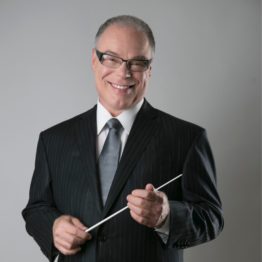
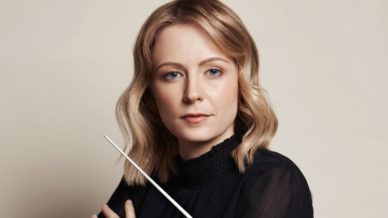
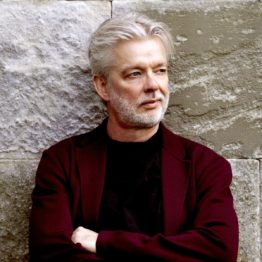
JEFF TYZIK conducts

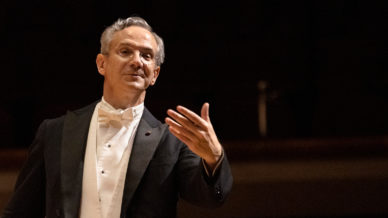
Back to the 80’s is a power-packed concert of the decade’s #1 hit songs, including The Power of Love, Time After Time, Material Girl, Another One Bites The Dust, Footloose, Addicted to Love and many others. Featuring the music of such 80’s iconic stars as Madonna, Debbie Gibson, Huey Lewis & The News, Phil Collins, Queen, Joe Cocker, and others, Back to the 80’s contains all new arrangements by GRAMMY® Award-winner Jeff Tyzik and features three dynamic soloists who will bring the decade alive.


Join us before the concert and during intermission for An Evening at the Symphony, a musical celebration of the 1980s with local LGBTQIA+ organizaitons, presented by Dallas Symphony Pride.

Dallas Symphony Young Professionals Logo

Our Dallas Symphony Young Professionals will be in attendance to this performance. Learn more about how to become involved in DSO YP here!


MORTON H. MEYERSON SYMPHONY CENTER
2301 Flora St.
Dallas, TX 75201

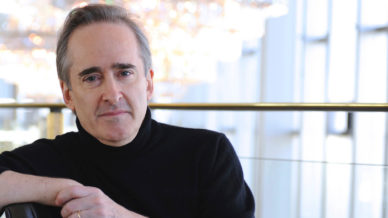
JEFF TYZIK PRINCIPAL POPS CONDUCTOR DOT & PAUL MASON PODIUM

Jeff Tyzik

Principal Pops Conductor

Dot & Paul Mason Podium

Read More

CHRISTIAN SCHMITT organ

BACH Passacaglia and Fugue
ARVO PÄRT Annum per annum (Year by Year)
FRANCK Chorale No. 3
THEO BRANDMÜLLER “Die Kruezigung” (The Crucifixion) & “Pieta” from Sieben Stücke zur Passionszeit (Seven Works for Passiontide)
CHARLES MARIE WIDOR “Moderato” from Symphony No. 10, “Romane”
LISZT Prelude after J. S. Bach “Cantata Weinen Klagen Sorgen Zagen”

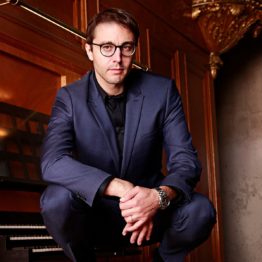
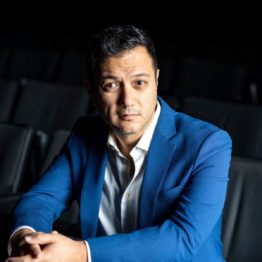
With invitations from the Berliner Philharmoniker, the Salzburg Festival and the Musikverein Vienna, ECHO award winner Christian Schmitt is undoubtedly one of the most sought-after concert organists of our time. Known for his virtuosic and charismatic playing, Christian is an “Artist in Focus” of the Tonhalle Orchestra Zurich as well as curator of the “International Organ Days.” Join us in welcoming him to the Meyerson!

MORTON H. MEYERSON SYMPHONY CENTER
2301 Flora St.
Dallas, TX 75201

Gould Family Organ Recital Series

Christian Schmitt, Organist

Christian Schmitt

Organ

Read More

CHERRY RHODES organ

BACH Präludium und Fuge e-moll
WILLIAM GRANT STILL Reverie
JEAN GUILLOU Ballade Ossianique No. 2, “Les chants de Selma”
FR. JOSEPH WALTER Chorale, Diferencias, & Glosas on Puer Natus in Bethlehem
LOUIS VIERNE Pièces de fantasie, Suite No. 2, “Clair de lune”
MAX REGER Fantasie und Fuge d-moll

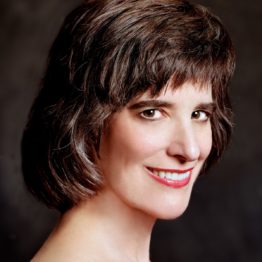
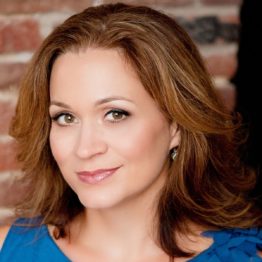
Cherry Rhodes is the first American to win an international organ competition (Munich). She has toured extensively through major music capitals of America, Europe and Asia with recitals in world-renowned cathedrals, churches concert and concert halls including Notre Dame, Royal Festival Hall (London), International Performing Arts Center (Moscow), Walt Disney Concert Hall, Lincoln Center and Kennedy Center. She returns to the Meyerson Symphony Center after having last performed here in 1993.

Gould Family Organ Recital Series

Cherry Rhodes

Cherry Rhodes

Organ

Read More

Program Notes

by René Spencer Saller

Orphaned at age 10, Bach moved in with his older brother Johann Christoph, an
organist at St. Michael’s Church in Ohrdruf, a small town in the German state of
Thuringia. Young Johann Sebastian was a quick study. Before he was out of his teens,
he was in demand as a professional organist. Within a few years, he was the leading
organist of his age. By all accounts, he was an extraordinary virtuoso, wowing
onlookers with his fleet passagework and nimble feet, but he was also an expert on
the mechanics of the instrument. He was often asked to try out new organs and tune
them to his exacting specifications, and he took an obsessive interest in the acoustic
properties of the halls and churches that housed the instruments.

Although establishing firm dates is often impossible, Bach probably composed most
of his major organ works between 1708 and 1717, when he was court organist for
Dukes Wilhelm Ernst and Ernst August in Weimar. During those years he produced
the Orgelbuchlein (The Little Organ Book); working drafts of the “Great 18
Chorales; most of his finest surviving preludes and fugues; and countless
transcriptions of Vivaldi concertos.

His Prelude and Fugue in E Minor seems to have been completed several years later,
however, most likely between 1727 and 1736, when he was working in Leipzig.
Somewhat unusually for Bach, the autograph fair copy of the score still exists,
although the handwriting changes to that of a studentcopyist 22 measures into the
fugue.

A Closer Listen
Ranked by Franz Liszt as one of Bach’s six greatest works in its genre, BWV 548 is a
master class in organ writing. The prelude is both elaborate in its detail and grand in
its scope. Likewise, at 231 measures, the fugue is one of Bach’s most intricate and
monumental. The work’s nickname, “the Wedge,” refers to the first half of the fugue
subject: as the idea develops, following a characteristic pattern of descending
chromatic fourths, Bach seems to create a kind of musical “wedge” against the home
key, butting up against it to create more harmonic space. The fugue is organized in
three parts, but the third is a notefornote repetition of the first. The central section
contains most of the daunting toccatalike passagework.

Nicknamed the “Dean of AfricanAmerican composers,” Still wrote more than 150
works, including eight operas and five symphonies. He was the first Black American
to compose a symphony that was performed by a major orchestra, and the first to
conduct a major orchestra. In 1949 his opera about Haiti, Troubled Island, was
produced by the New York City Operaanother historic first.

Still was born in Woodville, Mississippi, to collegeeducated teachers. His father, the
town bandmaster, died when he was three months old. He and his mother moved to
Little Rock, Arkansas, where she remarried. He began taking violin lessons at age 14
and taught himself viola, cello, double bass, clarinet, oboe, and saxophone. In 1911
he enrolled at Wilberforce College in Ohio, where he directed the band. His studies
at Oberlin Conservatory of Music were interrupted by a stint in the Navy. After
completing his service, he played as a sideman for blues legend W.C. Handy, who
brought him to Memphis and then New York City, where he became an oboist in
Eubie Blake’s pit and made arrangements for theater orchestras and jazz and blues
artists. He also studied with the influential atonalist Edgard Varèse.

Reverie was a commission by the Long Beach, Los Angeles and Pasadena and Valley
Districts Chapters of the American Guild of Organists in Celebration of the A.G.O.
National Convention July 26, 1962. About four minutes long, the piece mixes
several seemingly incompatible musical idioms into a coherent original language.
Still’s melodymeandering, melancholy, throughcomposedevokes African
American spirituals, but the dreamy harmonies and textures sound intensely
French.
Guillou was a true polymath: a composer, organist, pianist, poet, author, and
teacher. He was only 12 when he was appointed organist at the church St. Serge, in
his native Angers. Later, at the Paris Conservatoire, he studied with Marcel Dupré,
Maurice Duruflé, and Olivier Messiaen, three titans of the French organ tradition. In
the mid50s, Guillou taught organ and composition at the Institute of Sacred Music
in Lisbon and began writing music himself. In 1958 he moved to Berlin to obtain
medical treatment for a chronic condition. During these years he continued to
compose original music and made his first recordings at Lutherkirche and St.
Matthias Church.

In 1963 he returned to Paris. For the next 52 years, until 2015, he served as titular
organist at SaintEustache in Paris, where he was known for his brilliant
improvisations and distinctive transcriptions of composers whose works might
have otherwise seemed illsuited to the organ repertoire. He strongly believed that
his instrument belonged in concert halls as well as churches and cathedrals, and he
often performed internationally: in 1966 he played Max Reger’s Fantasia and Fugue
on BACH, Op. 46, at the Berlin Philharmonie, to commemorate the 50th anniversary
of Reger’s death.

Guillou composed more than 90 works for organ, orchestral, and chamber music,
and made many transcriptions, as well as more than 100 recordings. He also
published several books, including collections of poetry.
Guillou wrote the complex and technically challenging Ballade Ossianique, No. 2 in
1971 and revised it in 2005. He dedicated it to Cherry Rhodes, his former pupil and
assistant for two years at SaintEustache.
The Composer Speaks
“The present composition, recast several times, represents the final version of what
was originally, like some of the Sagas, one of my recorded improvisations. After the
ongoing growth of a note from pianissimo to the fortissimo of a chord thrust out like
a cutting sword, undulating phrases conjure up a landscape shrouded in mist. The
ongoing note appears, and soon isolated notes, falling like drops of rain in a cave,
seem to constitute the outline of a melodic figure in embryo. This latter, after
numerous episodes of expectancy and sometimes menacing solitude, gradually
takes shape, as though feeling its way through the darkness. Periodically,
developmental passages are interrupted by the insistent note, which each time
seems keen to push back the hostile forces. The thematic cell, the sole cell
constituting the constructional element of the whole work, now flares up and breaks
through the innumerable shifting forces. At last a kind of transfiguration takes place
in this torment, giving way to a concluding hymn full of enthusiasm and
jubilation.”Jean Guillou
Walter began composing music in high school, starting off with musicals. He earned
his MFA from the State University of New York at Buffalo, where he studied
composition with Morton Feldman and William Kothe.

In addition to being a teacher and composer, Walter also serves as a pastor for two
parishes in Fredonia, New York.

Rhodes has debuted other works by Walter, including Variations on Salve, Festa Dies
for Two Organs (1999) and the related Meditations on Salve, Festa Dies, for organ
solo (2002). With Rhodes in mind as organist, Walter spent threeandahalf years
writing the Chorale, Diferencias and Glosas on Puer Natus in Bethlehem, completing
the work in 2016. He was inspired by a 13century Gregorian chant, a Christmas
hymn.

In a telephone interview published in the New York Observer around the time of the
premiere, Walter remarked that Rhodes is “a virtuoso, and it takes a virtuoso to play
the piece, as it’s not an easy piece to perform.” The Diferencias (similar to a
development section in sonata form) and Glosas (ultraembellished variations) are
musical procedures associated with Spanish Renaissance composers such as
Antonio de Cabezon. Among the many delights in this vivid and virtuosic 17minute
work is a pedalsonly cadenza.

The Composer Speaks
“While the work is not intended to be programmatic, one may look upon it as loosely
reflective of the hymn’s ideas and sentiments. These embrace both the tenderness of
the newborn Babe, who is Divine Love made visible, and the power of the
Incarnation, which restores order to the cosmos, bringing salvation to a world
sorely in need of redemption.”

“I came into the world almost completely blind, on account of which my parents felt
a very keen chagrin,” Vierne recalled. With the aid of a powerful magnifying glass, he
studied counterpoint under César Franck, whom he first encountered at age nine,
when the older man’s powerful performance at SainteClotilde inspired Vierne to
become an organist. After the death of his first mentor, he turned to CharlesMarie
Widor, another giant of the French symphonic organ tradition. Although Vierne
became a revered professor himself, he still showed Widor drafts of everything he
composed well into his late 30s.

From 1900 until his death, Vierne served as principal organist at Notre Dame
Cathedral, in Paris. The stateoftheart CavailléColl instrument, with its
unprecedented range of registrations, fully exploited the tonal possibilities of the
evolving French “symphonic style.” Vierne’s six organ symphonies are hallmarks of
the genre. His Pièces de fantaisie, four sixmovement suites, were composed in 1926
and 1927 for his wildly successful American tour. “Claire de lune” comes from Suite
No. 2, where it serves as the penultimate movement. Although Vierne greatly
admired Claude Debussy, this long, highly expressive Adagio in Dflat major isn’t
especially indebted to the more famous piano piece by that name.

Although many critics consider him the greatest composer of organ music since J.S.
Bach, Reger is somewhat neglected today. Born in Brand, Bavaria, he received his
early training from a Weiden organist, Adalbert Lindner, who recommended him to
his own former master, Hugo Riemann. Under Riemann’s tutelage, Reger immersed
himself in the study of counterpoint and other formal procedures, poring over
Brahms and Bach scores to master the nuances of variation, fugue, and fantasia. He
finished his studies and then taught music theory until his compulsory year of
military service began in 1896. After a few years recuperating from this experience,
which he found highly traumatic, he moved from Weiden to Munich, where he
taught music and launched a pointless and polarizing campaign against Riemann,
his former master. He called this harsh rhetoric a “war of progress,” but it certainly
didn’t take his career very far.
During this period (roughly the first decade of the 20th century), Reger wrote many
major organ compositions. Intensely chromatic, with smeary chords and abrupt
modulations, they are notoriously difficult. Unsurprisingly, they weren’t very
successful, either commercially or critically. They did, however, bring Reger his
most important disciple: the organist Karl Straube, who almost singlehandedly
ensured their place in the organ virtuoso’s repertoire.

With the assistance of Straube, Reger completed his Fantasie und Fuge in D Minor
on March 1, 1916. The 43yearold composer died of a heart attack in a Leipzig hotel
room two months later, before the work’s premiere and publication. Dedicated to
Richard Strauss, the Romantic, technically tricky diptych is one of his last
compositions. The Fantasie presents the main theme, decorated and in different
voices. The Fugue consists of two contrasting parts: one somber and somewhat
dense, the other lively and transparent. Reger’s original manuscript bears a
handwritten note by Elsa Reger, the composer’s wife: In memory of my dear
godson Max Hanfried Poppen, from Frau Max Reger, Munich April 1937.”

PINCHAS ZUKERMAN conductor & soloist

BEETHOVEN Concerto in D major for Violin and Orchestra

ELGAR Variations on an Original Theme, “Enigma Variations”

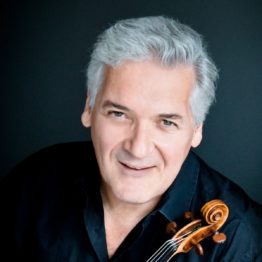
Pinchas Zukerman reigns as one of today’s most sought-after and versatile musicians. He is renowned as a virtuoso, admired for the expressive lyricism of his playing, singular beauty of tone and impeccable.

Joins us as he plays and conducts Beethoven’s Concerto in D major, one of the most mentally and emotionally demanding violin concertos of all time, and the ever-popular Elgar’s “Enigma” Variations, featuring the beloved Nimrod variation. Involving 14 variations on the original theme, the whimsical concept is explored in sincere detail, allowing for a spirited finale following Beethoven’s technical masterpiece.

Pinchas Zukerman

Pinchas Zukerman

Viola, Violin, Conductor


Read More

Program Notes

by René Spencer Saller

Beethoven’s Violin Concerto in D Major—his first and only violin concerto—was seldom performed during his lifetime. Luckily, 17 years after the composer’s death, it was rescued from undeserved obscurity by Joseph Joachim and Felix Mendelssohn, who, as soloist and conductor, respectively, performed the concerto so brilliantly that it quickly became a staple of the concert repertoire, as it remains today.

Beethoven wrote the D Major Concerto during the most productive period of his life. For years he had known that he was going deaf, a crisis that pushed him deeper into his work and invested it with a new expressive urgency. His so-called middle period (from approximately 1804 to 1812) is lousy with masterpieces. In 1806 alone, he finished the Leonore Overture No. 3, the Fourth Piano Concerto, the Fourth Symphony, 32 Variations on an Original Theme in C Minor, and the three Razumovsky Quartets. He also accepted a commission from the superstar violinist Franz Clement, whom he had known since 1794, when Clement was a 13-year-old prodigy. The Violin Concerto is dedicated to the virtuoso, and its first performance took place at a benefit concert for him.

The premiere, in December 1806, was not a success. The audience cheered Clement but seemed puzzled by Beethoven’s music. According to some contemporary accounts, Clement hammed it up by interpolating a splashy composition of his own, played on one string of his upside-down violin. Such show-biz shenanigans were common in the early 19th century and probably not the reason that the concerto flopped. It’s more likely that Beethoven’s chronic procrastination resulted in a substandard, under-rehearsed performance by the soloist and the orchestra—Beethoven was scribbling out revisions mere days before the scheduled concert. But even more daunting were the many liberties that he took with sonata-allegro form. Ridiculing the ruptures in continuity and the “needless repetition of a few commonplace passages,” an early critic darkly predicted that “if Beethoven will pursue his present path, he and the public will come to no good end.”

A Closer Listen

Right away, the concerto announces its consummate weirdness. It begins, unlike any concerto before it, with five soft taps on the timpani. Then the woodwinds introduce a serene melody, only to be interrupted by the violins’ strange mimicry of the timpani’s opening knocks. This rhythmic motif—sometimes four beats, sometimes five—recurs throughout the symphony, in many disguises, informing every melody and inspiring dozens of variations. After a lengthy orchestral buildup, the solo violin finally enters, playing a melody that has previously appeared only in tantalizing snippets. Its beauty aside, this solo is no show-off’s showpiece. Beethoven makes it clear that the soloist and orchestra are equal partners, with a shared goal.

In the lyrical Larghetto, serene strings float in a shimmering pool of G major. The theme surfaces, sung by muted strings, and the soloist spins out a series of increasingly complex variations.

After a brief cadenza, the last movement—played without pause after the central Larghetto—reveals itself as an unorthodox rondo. As it builds to a close, the finale generates a flurry of robust and virtuosic passages.

The son of a piano tuner and music-shop owner, Elgar grew up Catholic and working class in Worcester, England. Although his formal training was spotty, he learned to play the violin, bassoon, and organ and began composing at age 10. He became a freelance musician at 16, picking up orchestral and conducting gigs around Worcester and taking on the occasional violin pupil. In 1885, at 28, he succeeded his father as organist of St. George’s Church.

Four years later, he married Caroline Alice Roberts, the blue-blooded daughter of the late Major General Sir Henry Gee Roberts. A decade older than Elgar, Alice, as she preferred to be called, believed in her young husband’s genius and didn’t mind subsidizing it. Until 1899, when he finally found fame with Variations on an Original Theme (commonly known as the Enigma Variations), Elgar hustled in obscurity. Were it not for strong-willed, endlessly devoted Alice—who violated several social taboos when she married “below her station,” over the strenuous objections of her family—Elgar might not have had the leisure to compose.

Clues and Ciphers

The work that would finally make Elgar famous, at age 42, was a happy accident. After a long day teaching violin in Malvern, he liked to relax by improvising at the piano. Before long, he arrived at the tune he would later call “Enigma”; he knew he had his theme when Alice mentioned how much she liked it. He continued to entertain her by performing a series of variations inspired by their friends, beginning with Billy Baker (identified in the score as W.M.B.). Each variation is an attempt to channel a particular personality, to write in the distinctive styles that Elgar imagined his friends might employ were they “asses enough to compose.”

We now know the real-life counterparts for each of the 14 character sketches: from the composer’s wife (C.A.E.), to whom he whistled a special tune on arriving home each evening, to his great friend and champion Augustus Jaeger, here referred to as “Nimrod,” after the mighty hunter in the Bible, because his friend’s surname means “hunter” in German. Other variations are linked to colleagues, neighbors, and students, each subject characterized by the composer’s memories and impressions: the sweet stutter of graceful Dora Penny (“Dorabella”); the études of his viola student Isabel (“Ysobel”); the antics of George Sinclair’s clumsy bulldog, Dan; Lady Mary Lygon’s trip to Australia (listen for quotations from Mendelssohn’s Calm Sea and Prosperous Voyage).

For the finale he offers a self-portrait, labeled “E.D.U.” Alice’s nickname for him was “Edoo,” short for “Eduard,” an alternative spelling of “Edward.” Here he reprises themes from the “Nimrod” and “C.A.E.” variations, in honor of the “two great influences on the life and art of the composer,” as he wrote years later. It’s beautifully recursive: he describes them in music, then quotes from these musical descriptions to describe himself. He made them, maybe, but he’s also made of them.

Always Offstage

Although Elgar eventually confirmed the identities of each musical portrait, the wistful G-minor “Enigma” theme is eternally enigmatic. Over the years, music scholars have proposed countless sources for this melody, ranging from “Rule Britannia” to Mozart’s “Prague” Symphony, but all they can do is guess. As Elgar explained, the theme’s “dark saying” will always be a secret: “I warn you that the connection between the Variations and the Theme is often of the slightest texture; further, through and over the whole set another and larger theme ‘goes’ but is not played…. So the principal Theme never appears, even as in some late dramas… the chief character is never on the stage.”

THURSDAY 3/2/23 PERFORMANCE CANCELLED
Due to tonight’s inclement weather, we are very sorry to announce the cancellation of our Thursday performance. Ticketholders may contact us at customerservice@dalsym.com to exchange or donate their tickets.

PAUL MCCREESH conducts
SUSANNA PHILLIPS soprano
SARI GRUBER soprano
NICHOLAS PHAN tenor
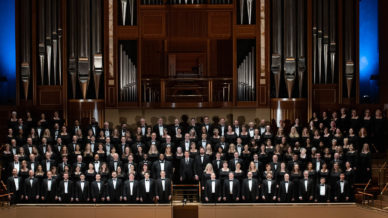
DALLAS SYMPHONY CHORUS

PARRY Blest Pair of Sirens
MENDELSSOHN Lobgesang (A Symphony Cantata)

Paul McCreesh joins the DSO to conduct a grand spiritual concert including vocal soloists, the Dallas Symphony Chorus and the Lay Family Organ. Also known as his Symphony No. 2, Mendelssohn described the work as a “symphonic cantata.” Bearing a superficial similarity to Beethoven’s Ninth Symphony, it begins with three instrumental movements although on a much smaller scale and closes with a cantata-like structure for chorus, solo voices and orchestra.

Blest Pair of Sirens is a short work for choir and orchestra by English composer Hubert Parry, who was commissioned to compose a piece for the Bach Choir of London to commemorate the Golden Jubilee of Queen Victoria. The Glories of our Blood and State was to be used, but subsequently scrapped possibly due to lines including “Sceptre and crown must tumble down” not being the most suitable for the event.

Parry then decided to set Milton’s At a Solemn Music garnering immediate success and eventually being recognized as an outstanding English choral work.

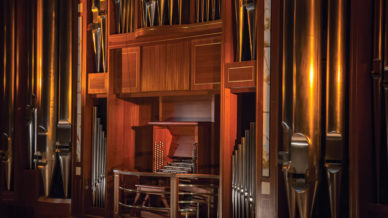
Program features the Lay Family Concert Organ.

NOTE: This performance will be performed without intermission.

MORTON H. MEYERSON SYMPHONY CENTER
2301 Flora St.
Dallas, TX 75201

Paul McCreesh

Conductor

Read More
Susanna Phillips

Susanna Phillips

Soprano

Read More
Sari Gruber

Sari Gruber

Soprano

Read More
Nicholas Phan

Nicholas Phan

Tenor

Read More

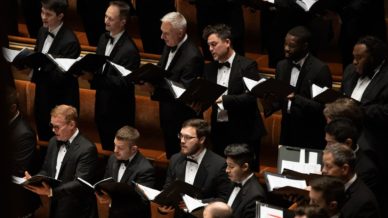
Dallas Symphony Chorus

Chorus

Read More

Program Notes

By René Spencer Saller

As a student at Eton, Parry studied composition and counterpoint with George Elvey, the organist of St. George’s Chapel, at Windsor. Although he distinguished himself in music, greatly impressing the Oxford Professor of Music Sir Frederick Ouseley with his examination cantata, he took the more conventional path instead: at Oxford he read law and modern history in preparation for a business career, studying music, his true love, on the side.

Despite his early triumph with the aforementioned cantata, which was performed and published to some acclaim, Parry got a relatively late start as a composer. He began producing his major works in 1880, when he was 32 and still unhappily employed as an insurance underwriter at Lloyd’s of London. In the 1870s he started contributing to George’s Grove’s Dictionary of Music and Musicians. (As it happens, Grove, a friend as well as colleague, suggested the John Milton ode that Parry used as a subject for his breakthrough choral composition, Blest pair of Sirens.) In addition to his entries for Grove’s Dictionary, Parry wrote music-history books, including a study of J.S. Bach that was published in 1909.

Beginning in 1882, Parry taught at the Royal College of Music in London, becoming director in 1894. Among his more famous pupils were Ralph Vaughan Williams, Gustav Holst, Frank Bridge, and John Ireland. Parry was knighted in 1898 and made a baronet four years later. He died at age 70 after contracting Spanish flu in the global pandemic of 1918.

Blessed Breakthrough

In 1887 the Anglo-Irish composer and conductor Charles Villiers Stanford, Parry’s colleague at the Royal College of Music, commissioned Parry to write a new piece for the Bach Choir of London in honor of Queen Victoria’s Golden Jubilee. Although Parry was still largely unknown, at least by the greater public, Stanford, one of his earliest supporters, considered him the greatest English composer since Purcell. The commission, Stanford’s first, yielded Blest pair of Sirens, Parry’s setting of a 1645 ode by John Milton, “At a Solemn Musick.” It would be Parry’s first major choral work—and his critical and commercial breakthrough. Since its 1887 premiere, it has remained a staple of the British choral repertoire.

Despite the fact that Milton, an outspoken anti-monarchist, supported Cromwell in the English Civil War and was arrested, imprisoned, and heavily fined for his revolutionary political tracts, Blest pair of Sirens delighted the many royalists at its premiere, in London’s St. James’s Hall: Parry proudly reported that it was received “quite uproariously.” More recently, Blest pair of Sirens was performed at the 2011 wedding ceremony of Prince William and Kate Middleton, now the Prince and Princess of Wales.

The two sirens referenced in the title refer to those “sphere-born harmonious sisters, voice and verse,” whom Milton entreats to “wed their divine sounds, and mix’d power employ.” Scored for orchestra and chorus, “Blest pair of Sirens” consists of one very long (but entirely grammatical) sentence, which takes up all but the last four lines, a concluding exhortation:

O may we soon again renew that song,
And keep in tune with heaven, till God ere long
To his celestial concert us unite,
To live with Him, and sing in endless morn of light!

Despite their brevity on the page, those final four lines bear a significant part of the ode’s rhetorical burden, and Parry lingers over them accordingly: from a total of 256 measures, he allots them nearly 100. Milton’s poem describes the speaker’s impassioned response to sacred music, a divine taste of what he expects to hear in the afterlife. Parry’s setting, with its eight-part counterpoint and intricately interwoven lines, brings the poem back to its inspiration: Baroque sacred music. But Parry’s music also draws on Wagnerian “endless melody” and Brahmsian harmonies, lending a peculiar timelessness to the composition. Suspended in the sweet spot between ecstasy and awe, Blest pair of Sirens transforms experience into epiphany.

Mendelssohn made the most of his brief charmed life. His wealthy parents ensured that he had the finest possible education, and they turned their Berlin mansion into a concert hall twice a month, promoting their young son as a musical prodigy. When he was 12 years old, he met the elderly Goethe, who rhapsodized about the boy’s genius: “What [Mendelssohn] already accomplishes bears the same relation to the Mozart of that time that the cultivated talk of a grown-up person bears to the prattle of a child.”

Before Mendelssohn was out of his teens, he had completed approximately 100 compositions, including operas, quartets, concertos, and a magnificent octet for strings. By age 20 he had written his famous overture after Shakespeare’s A Midsummer Night’s Dream and conducted Bach’s St. Matthew Passion to rave reviews. He visited the United Kingdom on several occasions and greatly impressed Queen Victoria and her spouse, Prince Albert. The royal couple, both quite musical, invited Mendelssohn to play for them on numerous occasions; he even accompanied the Queen while she sang some of his and his sister Fanny’s songs at Buckingham Palace.

Mendelssohn, Jewish at birth, converted to Lutheranism in early childhood, along with the rest of his immediate family (Felix and his siblings in 1816, their father six years later). Around the same time, the family added the Protestant-sounding surname Bartholdy to their original last name; Felix’s uncle Jakob Salomon, his mother’s brother, had adopted that name some years earlier, upon his own conversion to Christianity. Although the Mendelssohn family almost certainly would have stayed Jewish in a less oppressively anti-Semitic environment, the composer fully embraced his new religion and remained a devout Lutheran all his life.

In 1840, when Mendelssohn wrote his Symphony No. 2 in B-flat Major, he was routinely working himself to exhaustion. Since his appointment five years earlier as the conductor of the Leipzig Gewandhaus Orchestra, he had successfully transformed the ensemble into one of the finest in Germany, arguably the world, and he constantly strove to improve. A groundbreaking music director and maestro, he was one of the first conductors to lead an orchestra with a baton, and many of his programming practices—such as mixing familiar repertoire with newer, more challenging fare—are now the norm in concert culture. During this time Mendelssohn was also laying the groundwork for the conservatory that he would help found in 1843.

Happily married since 1837 to Cécile Jeanrenaud, a beautiful clergyman’s daughter, Mendelssohn adored his young wife and their growing family. (The decade-long marriage produced five children.) But the composer’s hyperactive work schedule, combined with his exacting standards and superhuman ambition, surely contributed to his early death. When his beloved sister, esteemed colleague, and lifelong confidante Fanny died of a stroke in 1846, Mendelssohn reportedly shrieked and fainted, rupturing a blood vessel in his brain. Although he lived for another year, he was in severe physical and emotional pain until he succumbed to the family malady at 38.

In Praise of Print

In 1840 dozens of festivities took place across Germany to mark the 400th anniversary of the Gutenberg moveable-type press. Leipzig enjoyed special prominence as a publishing center, and an elaborate three-day music festival was staged for that June featuring, among other events, two new major works composed and conducted by Mendelssohn: the monumental Festgesang, sometimes called the “Gutenberg Cantata,” scored for a 200-voice male chorus and two enormous brass bands; and a “symphony-cantata” scored for orchestra, chorus, three solo singers (a tenor and two sopranos, or tenor, soprano, and mezzo-soprano), and organ.

The Leipzig-based music publisher Breitkopf & Härtel prefaced the score for the symphony-cantata with a quotation by Martin Luther: “Rather I wished to see all the arts, especially music, serving Him who gave and created them.” Below the Luther quotation was a title that reinforced its devotional purpose: “Lobgesang/Eine Symphonie-Cantate/nach Worten der heiligen Schrift, componiert/von Felix Mendelssohn-/Bartholdy” (Hymn of Praise/A Symphony-Cantata/ after Words of the Holy Scripture, composed/by Felix Mendelssohn-/Bartholdy). The connection between print and the Bible would have seemed obvious to Mendelssohn and his fellow Lutherans: Gutenberg’s first significant publication on his new press, the text that would ensure his fame hundreds of years later, was a German-language edition of the Bible, based on Martin Luther’s own translations of the scriptures.

Mendelssohn’s hybrid genre, the “symphony-cantata,” provoked comparisons to Beethoven’s iconic Ninth Symphony, which had debuted only 16 years earlier. Although the similarities between the two works are obvious enough, they are also fairly superficial. In the Ninth Beethoven waits until his climactic finale to unleash the chorus and its ecstatic “Freude” juggernaut. Mendelssohn, like his esteemed predecessor, starts his symphony with three purely orchestral movements, but what follows is a lengthy cantata, not a single-movement choral finale. The cantata alone consists of 10 or so numbers, depending on how you count them. Combined, the symphony and cantata are nearly twice as long as any of Mendelssohn’s purely instrumental symphonies.

Along with the inevitable Beethoven comparisons, Lobgesang garnered positive reviews, most notably from Mendelssohn’s friend and colleague, the composer-critic Robert Schumann, who attended the premiere and reported that “the work was enthusiastically received, and its choral numbers especially must be counted among the master’s freshest and most delightful creations; and what this praise means, after his great achievements, will be understood by everyone who has followed the evolution of his compositions.”

A Brief Note on Nomenclature

Mendelssohn’s symphonies are numbered according to their date of publication, not composition. Although only the second to be published, Symphony No. 2 was the second to last symphony that Mendelssohn composed. He died seven years later, after suffering a series of strokes. After his death, the Lobgesang Symphony-Cantata was republished, this time as Symphony No. 2 in B-flat major, a designation that the composer never sanctioned, insofar as he never considered it a symphony, strictly speaking.

A Closer Listen

The opening instrumental movements are played attaca, a feature distinguishing the work from its Beethovenian model, as Schumann noted in his review: “[T]he three orchestral movements proceed without any pause between them—an innovation in the symphonic form. No better form could have been selected for this special purpose.”
The first movement (Maestoso con moto – Allegro) begins with a bracing theme from the trombones, which will recur in subsequent movements, eventually serving as the melody for the words from Psalm 150 that open the cantata portion of the symphony: “Alles, was Odem hat, lobe den Herrn” (Everything that has breath, praise the Lord). This fanfare-like ascending motif is flexible enough to convey both effort and euphoria: a kind of relentless joy. When Mendelssohn conducted the work in Düsseldorf in 1842, the audience erupted into spontaneous applause as soon as the trombones reprised the theme, right before the entrance of the chorus, and Mendelssohn had to start that section over from the top.

After the spellbound second movement, a fleet minuet and trio marked Allegretto un poco agitato, the Adagio religioso conjures up the calm before the storm: the joyous onslaught that is the opening of the cantata. In addition to the three solo singers, the chorus is divided and subdivided into various groupings, which both support the soloists and function as distinctive voices, albeit of a collective identity. Among the many highlights of the cantata section is “I waited for the Lord,” an exquisite duet for sopranos and chorus. Graced by a lambent horn, intertwined melodies, and thrilling close harmonies, the song became famous as a standalone piece later in the century. According to Schumann, people at the premiere responded to the duet right away. “There broke forth in the audience a whispering which counts for more in the church than loud applause in the concert-hall,” he reported in his review. “It was like a glimpse into a heaven of Raphael’s madonnas’ eyes.”
Less celebrated but equally outstanding is the tenor’s aria “The sorrows of death,” an anguished, ardent cri de coeur that contrasts perfectly with the contrapuntal choral majesty of “The night is past,” which begins with the soprano soloist’s unassailable declaration of same. (Lighten up for the Enlightenment, you might say.) The remaining three numbers sustain this mood of exalted service and enlightened devotion to the Lord. The hymn that powers the chorale, “Now Thank We All Our God,” was a particular favorite of Mendelssohn’s. The brief coda resurrects the opening motif, the mother lode of all that follows. First sung by the trombones, then by the chorus and remaining instruments, the “praise” theme brings the symphony-cantata full circle.

FABIO LUISI conducts
MATTHIAS GOERNE baritone

MAHLER Selections of Twelve Songs from Des Knaben Wunderhorn
BRAHMS Symphony No. 3

Although Brahms was just 50 when he wrote his Third Symphony, he looked back to younger days with the musical quotation of the motto Frei aber froh (“Free but happy”). In the rising exclamation from the winds that open this great symphony, the F-A-F motif hits you immediately. The compactness of the work intensifies the dramatic aspects of his third and penultimate symphony. As you listen to this richly romantic piece, you get a real sense that Brahms had hit his stride as a composer.

NOTE: The DSO will record this weekend’s performances of Brahms Symphony No. 3 for a future album release.


Join us after the concert on Saturday for Meet the Musicians! You’ll have a chance to speak with Dallas Symphony musicians in a casual happy hour setting and learn more about members of the orchestra.


MORTON H. MEYERSON SYMPHONY CENTER
2301 Flora St.
Dallas, TX 75201

FABIO LUISI MUSIC DIRECTOR LOUISE W. & EDMUND J. KAHN MUSIC DIRECTORSHIP

Fabio Luisi

Music Director

Louise W. & Edmund J. Kahn Music Directorship

Read More
Matthias Goerne

Matthias Goerne

Baritone

Read More

Program Notes

By René Spencer Saller

Mahler accepted his first paid conducting gig when he was only 20, presiding over third-rate operettas at a spa in Upper Austria. From then on, the ambitious and cash-strapped composer spent his entire life as a professional conductor, holding posts in Ljubljana, Kassel, Prague, Leipzig, Budapest, Hamburg, Vienna, and, at the end of his life, New York City. From the podium, he demanded much from each musician but gave even more, responding to the orchestra with an electric empathy and an intense physicality. Widely considered among the greatest conductors in the world, he applied his galvanizing intelligence to other composers’ scores, reinvigorating the repertoire and setting the interpretive bar impossibly high for future generations of professional maestros.

By 1888, when he began his Second Symphony, he was, if not as famous as he would someday become, widely well-regarded—as a conductor. As a composer, however, he felt misunderstood and undervalued, the eternal underdog. He wasn’t wrong. The disastrous premiere of his First Symphony in late 1889 hit him hard. Because of certain ugly socio-political and cultural realities—most obviously, an antisemitism so pervasive that it’s only remarkable in its occasional absence—Mahler’s career would be rocky, never mind his formidable talent and drive and his voluntary conversion to Catholicism.

After receiving a terminal diagnosis of heart disease in 1907, Mahler resolved to compose as much music as possible, of the highest possible quality, culminating in a flurry of late-life masterpieces, including Das Lied von der Erde, Symphony No. 9, and the unfinished Tenth. And despite being fired regularly for factors unrelated to his job performance, he kept conducting, leading the New York Philharmonic in the last two years of his life. He died at age 50, from complications of the heart condition that had been diagnosed four years earlier.

Wondrous Wunderhorn

In Mahler’s distinctive sound world, song and symphony are closely intertwined, even interdependent. His first four symphonies are called his Wunderhorn symphonies because they incorporate so many of his settings of texts from Des Knaben Wunderhorn (The Youth’s Magic Horn). This fanciful collection of German folk poetry, originally published between 1805 and 1808, was praised by literary luminaries like Goethe, who wrote of his hope that “this little book would find a place in every house where bright and vital people make their home…. Best of all, [that] this volume might lie on the piano of the amateur or master of musical composition so that these songs might come into their own by being matched to familiar and traditional melodies, that they might have appropriate tunes fitted to them, or that, God willing, they will inspire new and significant melodies.”
Eventually consisting of three volumes and a thousand or so poems, the Wunderhorn collection did indeed inspire a generation or two of Romantic composers and their successors. Among many others, Mendelssohn, Schumann, Brahms, Richard Strauss, and Schoenberg all wrote settings of these provocative and often grotesque fairy-tale poems, which touch on everything from famine to frivolous flirtation; from doomed drummers to fish prophets; from the magical riverine journey of a mower’s golden ring to the brutal execution of a child. The tales are spooky and preachy, pious and violent, funny and profound. For years they ignited Mahler’s imagination like nothing else.
Between 1887 and 1902, the year of his momentous marriage to Alma Schindler and the completion of his Fifth Symphony, Mahler set more than a dozen poems from the Wunderhorn collection for voice and piano or orchestra, and a half-dozen or so of these story-songs surfaced in the first five symphonies. In 1899 he published 12 of the Wunderhorn songs in the collection titled Humoresken (Humoresques)—informally, and confusingly, also known as Mahler’s “Songs from Des Knaben Wunderhorn.” Although Mahler had originally conceived these songs for voice and orchestra, he was shrewd enough to create alternative arrangements for voice and piano, tailored to the growing sheet-music market for amateur musicians.
Not all of the poems in the Wunderhorn collection are actual folk relics; some appear to be imitations or homages. The two editors, Achim von Arnim and Clemens Brentano, could also be described as authors—not so much disciplined collectors and compilers as resourceful recyclers and fabulists. The authenticity of any given tale mattered less to them than its entertainment value, and if they needed to invent certain details in the service of a greater truth, so be it. At any rate, Mahler, who was almost as sensitive to poetry as he was to music, took additional liberties with his source material, adding lines and verses as he saw fit. In fact, he wrote his own text for the 1892 song “Das himmlische Leben” (The Heavenly Life), which also served as the penultimate movement of his Fourth Symphony.
In addition to “Das himmlische Leben,” five other Wunderhorn songs functioned as pivotal movements in Mahler’s symphonies, including two featured in this concert: “Des Antonius von Padua Fischpredigt” and “Urlicht,” which did double duty in his Second Symphony as the Scherzo and fourth movement, respectively. Nicknamed the “Resurrection” Symphony, Mahler’s Symphony No. 2 in C Minor deals with death and rebirth, in the Christian tradition.

Born into a large and poor Jewish family, Mahler was still technically Jewish at the time of its composition. His interest in the spiritual aspects of Christianity predated his official conversion to Catholicism, in 1897, when he was 37 years old. Part of the reason he needed to make his faith a matter of public record was pragmatism, or self-preservation: the ever-worsening antisemitism of late 19th-century Austria made it impossible for a Jewish man, even an eminently qualified one, to land the desirable conducting posts, especially in Vienna, where Richard Wagner’s widow Cosima, the illegitimate daughter of Franz Liszt and a vicious antisemite, still exerted enormous influence.

A Closer Listen

1. “Rheinlegendchen” (Little Rhine Legend). Set in G major, with a 3/8 meter reminiscent of a Ländler, the richly evocative “Rheinlegenchen” is lightly scored—just a wind quintet with strings. It was so popular at its first performance that the audience demanded an immediate encore. The lyrics are sung from the perspective of a lovelorn young mower, who imagines what might happen to a ring tossed into the Rhine. The ring eventually ends up in the belly of a fish served at the King’s table, at which point, the mower predicts, the absent sweetheart will be unable to resist returning the ring—and returning the mower’s love. Throughout the song, Mahler sprinkles folk-inflected, improvisational-sounding riffs and licks, imparting a rollicking, rural flavor to the “little Rhine legend.”

The world premiere of the song took place at the Hamburg Konzerthaus, in October 1893, sung by Paul Bulss and performed by the Julius Laubesche Kapelle under Mahler’s own baton.

2. Composed in the summer of 1898 and published the following year, “Wo die schönen Trompete blasen (Where the Splendid Trumpets Sound), in C minor, is a strangely subdued song in which the singer assumes two roles: an ardent young woman and the soldier she loves, who may be a ghost—or, if not yet a ghost, a future ghost. Mahler contrasts the swooning, almost hallucinatory waltz of the lovers’ union with the doomy, inexorable 2/4 beat of the marching army, with its “splendid trumpets,” which are typically and unexpectedly soft when not actually muted. The song was first performed, along with “Das irdische Leben,” on January 14, 1900, sung by soprano Selma Kurz, with Mahler conducting the Vienna Philharmonic.

3. Completed in 1892 and first performed that December, in Berlin, “Verlor’ne Müh” (Wasted Effort) is another he-said-she-said dialogue song, with the singer again performing both male and female roles. Mahler deploys a lilting, Ländler-like 3/8 rhythm, along with sassy interjections and imitations. The comical lyrics are in the Swabian dialect (related to Alsatian and other Swiss-adjacent forms of German) and dramatize a persistent village maiden’s failed seduction of a young man, who not only rejects her offerings of “tender morsels,” “nibbles,” and “my heart,” but persists in insulting her, with increasing harshness, as a “foolish girl.” Her beloved, an obstinate and unloving prig, might get the last word, but the maiden gets the last laugh. (It’s safe to say that most of us, including the long-dead Mahler, would greatly prefer a leisurely meal with this agreeable, lamb-tending creature than another negging session with Buzzkill Boy.)

4. Mahler composed “Das irdische Leben” (The Earthly Life) sometime after early spring 1892. He shortened the source poem, originally titled “Verspätung” (Delay), but retained the haunting poignancy that befits a song about a child who begs his mother for bread until he starves to death: “And when at last the bread was baked/The child lay dead upon the bier.” Divided—and typically muted—strings convey the bereaved parent’s torment, that churning grief and choking helplessness. Early on, Mahler conceived of his Fourth Symphony (1899–1901) as a six-movement work that would also feature “Das irdische Leben” (The Earthly Life). This gritty ballad, a kind of proto-Kindertotenlied, serves as a dramatic counterpart to the celestial joy and abundance of “Das himmlische Leben” (The Heavenly Life), the spiritual climax of the Fourth Symphony.

5. Set in the remote key of D-flat major, “Urlicht” (Primal Light) functions in the Second Symphony as a transition, or a kind of introduction, to the finale. Mahler composed it in 1892 and orchestrated it the next year. His tempo indication is “Sehr feierlich, aber schlicht” (Very solemn, but simple). Originally written for mezzo-soprano or contralto, the singer’s radiant innocence transforms a simple declaration of faith into a passionate rhapsody. Listen to the winds curling around the singer’s voice; they seem to complete his thoughts, much as birdsong bends the night sky toward morning:
I am from God, I want to return to God.
The loving God will grant me a little light,
Will light my way to blissful life eternal and bright.”

6. Mahler repurposed “Des Antonius von Padua Fischpredigt” (Saint Anthony’s Sermon to the Fish,” in C minor, as the third-movement scherzo of his Second Symphony. Composed in summer 1893 and set in a dreamy 3/8, the song is marked “In ruhiger fließender Bewegung,” which in English means “In quietly flowing motion,” a fair description of its sound, if not its ironic humor. A magically twisty clarinet melody slips through skittery cross-currents of pizzicato and bowed strings as the singer describes the aquatic audience’s rapt attention to Saint Anthony. Like any good joke that lands, the song builds suspense through repetition, concluding with this devastating punchline on misplaced piety:

The crabs still go backwards,
The cod are still bloated,
The carp are still gorging,
The sermon’s forgotten.
The sermon was pleasing.
All stay as they were.

7. The intense and jarring “Revelge” (Reveille), also in C minor, depicts a death march: rattle-trap drums and strident trumpets, stomping feet and rotting corpses. The soldiers might as well be zombies, grimly enacting their pointless rituals at every predawn reveille, compulsively charging and slaughtering. The speaker is an army drummer, an adolescent, in fact, who has been wounded in battle and is now being left for dead, even trod on, by his marching comrades. The young drummer’s lament is all the more heartbreaking for its growing self-awareness:

“I will well play my drum
or else I will lose myself completely.
The brothers, plentiful sowed
tralali, tralalei, tralalera,
they lie as if they’ve been mowed.”
A revenant, he returns to his darling’s home, not yet aware that he’s dead. (Listen for the col legno strings, meant to mimic the grinding, scraping sound of bone on bone.) That morning, in a ghoulish twist, the drummer’s bones and those of his comrades appear arranged “in rank and file, like tombstones” at her front door, with the drum out in front “so that she can see him.” Mahler composed this song in July 1899.

8. Composed in summer 1901, around the time that he was beginning his Fifth Symphony, “Der Tambourg’sell” (The Drummer Boy) was the last of Mahler’s Wunderhorn settings—and wouldn’t you know it, it’s another song in C minor from the perspective of a doomed young drummer. This time the singer and first-person narrator is in prison, not underfoot on a bloody battleground, but he’s dying all the same: marched from his cell to the gallows. Never mind that he’s still a child—too young to fight, but old enough to be killed. The music, a protracted funeral march, is somber, even sepulchral.

As with “Revelge,” Mahler conjures up all manner of spooky effects from col legno strings. In an elegiac address to everything he can see on his march to the scaffold, the singer ticks off a series of farewells, repetitively, almost self-soothingly—think Margaret Wise Brown’s Goodnight Moon, only infinitely sadder—before closing with a pair of final, heartbreakingly understated “Gute Nacht”s. Mahler’s indications call for the first “good night” to start loud, then go suddenly quiet; the second is supposed to be sung “mit brechender Stimme” (with broken voice).

If all this sounds a bit morbid, it might help to remember that Mahler had almost died that February, when he woke in bed to find the sheets soaked in blood from a hemorrhage. He would marry the next year, but he would die within the decade, after suffering the grievous loss of his eldest daughter, Maria, who succumbed to scarlet fever.

In May 1883, Brahms turned 50. Richard Wagner, his esteemed adversary, had died a few months earlier; Clara Schumann, his intimate friend, cheerleader, and steadfast muse, was nearly 64 and quite frail; he had already outlived many friends and musical mentors. Yet he was robustly healthy, if somewhat fat, and had a lust for life—as well as for young women. That summer he followed one of them, the contralto Hermine Spies, to Wiesbaden, on the Rhine. There he composed his Symphony No. 3. It had been six years since his previous symphony, another product of a single fertile summer.
Although he continued to tweak the score until its publication, the Third was a triumph from the start. After he sent the score to Clara, she gushed, “From start to finish one is wrapped about with the mysterious charm of the woods and forests…. [By the finale] one’s beating heart is soon calmed down again for the final transfiguration which begins with such beauty in the development that words fail me!”

Except for the predictable demonstration from the Wagner Club, whose members briefly disrupted the Vienna premiere, Brahms’s Symphony No. 3 was hailed as a masterpiece by audiences and critics alike.

A Closer Listen

The shortest of Brahms’s four symphonies, the Third is formally rigorous and tonally inventive, thematically integrated and rhythmically complex. Unusually, all four movements end softly, even the seemingly heroic finale. The first movement begins with two audacious wind chords, a strong F major succeeded by a more tentative diminished chord—preparation for a series of wrenching major and minor shifts. Harmonic ambiguities and metrical instabilities abound. The figure that haunts all four movements, in various configurations, is the bass line: F–A-flat–F, Brahms’s personal motto. It stands for “Frei aber froh” (Free but happy), a play on his friend Joseph Joachim’s motto “Free but lonely.”

The more lyrical main melody is borrowed from Robert Schumann’s “Rhenish” Symphony. First presented by the strings, this theme imbues the entire work. It is an obvious tribute to Brahms’s late friend, the man who hailed the 20-year-old tavern pianist from Hamburg as the next Beethoven and set him up as his musical proxy in the so-called War of the Romantics—as the foil to Wagner and all that he represented. But as biographer Jan Swafford persuasively argues, Brahms’s Third recalls another Rhine besides Schumann’s, another monumental forefather: Wagner’s “atmospheric string textures,” his “grand triadic leitmotifs and themes” echo throughout. Ever the reconciler, Brahms united his mentor and his supposed rival in a symphony that ultimately stands for nothing beyond itself.

Free but happy indeed.

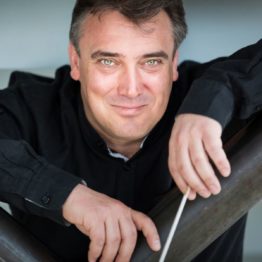
JUKKA PEKKA SARASTE conducts

SIBELIUS Pohjola’s Daughter
SHOSTAKOVICH Symphony No. 8

Known for his interpretations of Shostakovich, Jukka Pekka Saraste leads the DSO through his Eighth Symphony.

NOTE: No Intermission in this performance.

MORTON H. MEYERSON SYMPHONY CENTER
2301 Flora St.
Dallas, TX 75201

Jukka-Pekka Saraste, conductor

Jukka-Pekka Saraste

Conductor

Read More

Program Notes

by René Spencer Saller

Premiere: December 29, 1906, St. Petersburg; Jean Sibelius, conductor

Last DSO Performance: May 20 & 21, 2016; Karina Canellakis conductor

Before Sibelius became Finland’s first great composer, he yearned, against considerable odds, to perform professionally. Although he played violin as a child, he didn’t start formal lessons until he was 14. “The violin took me by storm,” he wrote, “and for the next 10 years it was my dearest wish, my greatest ambition, to become a great virtuoso.” At 25, after years of dogged study in Helsinki, Berlin, and Vienna, he auditioned for a place in the Vienna Philharmonic and was rejected.

Sibelius turned to composition instead and became a leading voice in the growing movement for Finnish independence. Like many Finns of his social class, the educated élite, he was ethnically Swedish and culturally Northern European: he grew up speaking Swedish, and studied music in Berlin and Vienna. Whereas most works of Romantic Nationalism incorporate native dances and songs, most of Sibelius’s melodies are invented. He had surely heard traditional Finnish folk tunes, but he seldom quoted them. Instead, he was inspired by nature and the Finnish national epic, the Kalevala, to create his own deeply personal form of folk music.  

His music also reflected a particular historical moment, one marked by popular unrest. After a century of Russian rule, the Finns began to protest against their compulsory conscription into the Russian military and their censorship by the occupying regime. The “February Manifesto” of Tsar Nicholas II, in 1899, gave the Russian government complete control over Finland, stripping all but symbolic power from the Finnish Senate. In November a group of Helsinki artists and activists organized several events in support of censored journalists. The earliest iteration of Sibelius’s iconic Finlandia, Finland Awakes, was the rousing finale for a series of patriotic historical tableaux that he wrote for one such event. More than 18 years would elapse before Finland would officially declare its independence from Russia.

A Finnish Fantasia

He called Pohjola’s Daughter a “symphonic fantasia,” a term he never used again. As with many of his other programmatic works, its source was the Kalevala. He composed the bulk of the “fantasia” between 1905 and 1906, not long after hearing Richard Strauss’s Ein Heldenleben in Berlin. Inspired by his German colleague’s opulent orchestration, Sibelius set out to create his own, distinctively Finnish take on the heroic tone poem. He found the project exhilarating. As he explained in a letter to Aino, “This is my genre!! Here I can move without feeling the weight of tradition.”

A Closer Listen

Sibelius might have emancipated himself from the weight of tradition, but he composed his free-form music with an ancient story in mind. He gave a German program to his publisher, translating the relevant lines from the Kalevala while preserving, to the best of his abilities, the striking, sing-song meter of the Finnish original.

The story involves the old sorcerer Väinämöinen, who falls for the imperious daughter of Pohjola. First seen perched on a rainbow, spinning a cloth of silver and gold, the icy maiden issues a series of impossible challenges, and when her poor suitor fails at the last one—carving a sea-worthy, self-propelled boat from the shards of her spindle—she laughs scornfully (listen for those stabbing, Psycho-esque strings!). Bloodied but wiser for his mistakes, the old sorcerer leaves her to travel on alone.

Premiere: November 4, 1943, Moscow; Yevgeny Mravinsky, conductor 

Last DSO Performance: October 2-5, 2014; Jaap van Zweden, conductor

By the mid-1930s, Socialist Realism was the only state-sanctioned musical style in Soviet Russia. Composers who had safely dabbled in avant-garde or neo-classical idioms a few years earlier learned to fear the wrath of Joseph Stalin and his cultural watchdogs. State-approved compositions typically incorporated folk songs and ended in a major key. Composers were expected to support the class struggle by honoring the proletariat and conveying strong Soviet values, as opposed to the apolitical, bourgeois individualism of the United States and Western Europe. Artists, writers, composers, and patrons who failed to conform to the new mandate were executed, imprisoned in gulags, or simply made to vanish.

One nerve-wracking aspect of the evolving Soviet rulebook was the inconsistent, even incoherent enforcement. A composer might never know whether he was being punished for the content of his work or for pettier, personality-driven reasons. Becoming too popular, for instance, was a surefire way to bring on a beat-down—symbolic if you were lucky, literal if you were not.

After getting slapped with a damning review of his successful opera Lady Macbeth of the Mtensk District in 1936 (anonymous but likely penned by Stalin himself) and an equally harsh critique of another, far less edgy composition the same year, Shostakovich was understandably terrified. He withdrew his Fourth Symphony before its premiere but after rehearsals had begun. His wife, the physicist Nina Varzar, gave birth to their firstborn daughter, Galina Dmitrievna, on May 30, 1936, which meant he had a fresh new life to worry about. Over the next several months, he kept his head down, busying himself with uncontroversial projects. He would not share the Fourth with the public until December 30, 1961.

Shostakovich was able to restore his good standing, at least for the time being, thanks to the sensational success of his Fifth Symphony in 1937. He even agreed to describe the D minor Symphony as “a Soviet artist’s reply to just criticism.” By this point, he knew exactly how to tiptoe around the government censors, although he sometimes felt compelled, whether out of bravery or sheer cussedness, to poke at them instead. This would not be the last time that he would offend the authorities, nor the last time that he would accept unjust criticism.

Six years later, despite being sick with a gastrointestinal infection, Shostakovich composed his Symphony No. 8 in C minor in a remarkably short time—officially, only two months, from July 1 to September 4, 1943, although he had probably worked out most of the music in his head before committing the notes to staff paper, as was his habit. Thanks to the monumental success of his Seventh Symphony (“Leningrad”), he enjoyed the luxury of composing without distraction on a state-sponsored sabbatical at the “Creative Home,” an isolated retreat maintained by the Union of Soviet Composers that was located about 150 miles northeast of Moscow—insulated from the noise and chaos of wartime. The work’s dedicatee, his fellow countryman and frequent colleague Evgeny Mravinsky, led the USSR Symphony Orchestra in the world premiere on November 4 that same year.

Although audiences seemed generally receptive to the Eighth, the authorities were not. They called it depressing, confusing and counter-revolutionary. By the end of World War II, Shostakovich’s Eighth Symphony had been effectively erased from the repertoire. Its follow-up, the studiously apolitical, neoclassical Ninth, was banned for the remainder of Stalin’s life and not recorded until 1956.

Erasure and Vindication

In 1948, five years after its premiere, the Eighth Symphony still managed to make trouble for Shostakovich. Andrei Zhdanov, the Soviet Minister of Culture and Shostakovich’s most powerful nemesis, yanked it from obscurity just so he could denounce it at length. Another member of the panel, Vladimir Zakharov, a Soviet functionary and a minor composer, described it as “not a musical work at all” and “repulsive and ultra-individualistic,” similar in sound to “a piercing dentist’s drill, a musical gas chamber, the sort the Gestapo used.” Shostakovich was also condemned for the “pessimism, unhealthy individualism, extreme subjectivism, and willful complexity” of his symphony. (Even Sergei Prokofiev, whose own works were routinely savaged by Stalin’s toadies, had trashed Shostakovich’s Eighth at a Composers’ Plenum four years earlier.) Zhdanov ordered that all copies of the score be recycled and all recordings destroyed.

According to his friends and his contested (and possibly semi-fabricated) memoir Testimony, Shostakovich considered the symphony a kind of Requiem for himself. As late as 1956, he complained that “the Eighth Symphony has remained unperformed for many years. In this work there was an attempt to express the emotional experiences of the People, to reflect the terrible tragedy of war. Composed in the summer of 1943, the Eighth Symphony is an echo of that difficult time, and in my opinion quite in the order of things.”

Two years later, the Central Committee conceded that the Eighth Symphony had, along with certain works by Prokofiev, Khachaturian and several other composers, been “indiscriminately denounced.” It returned to the active repertoire, where it remains.

The Composer Speaks

“I wrote it very quickly…When the Seventh Symphony was finished, I intended to compose an opera and a ballet and started work on an oratorio about the defenders of Moscow. Then I put aside the oratorio and began work on the Eighth Symphony. It reflects my… elevated creative mood, influenced by the joyful news of the Red Army’s victories…

“The Eighth Symphony contains tragic and dramatic inner conflicts. But on the whole it is optimistic and life-asserting. The first movement is a long adagio, with a dramatically tense climax. The second movement is a march, with scherzo elements, and the third is a dynamic march. The fourth movement, in spite of its march form, is sad in mood. The fifth and final movement is bright and gay, like a pastoral, with dance elements and folk motifs.

“The philosophical conception of my new work can be summed up in these words: life is beautiful. All that is dark and ignominious rots away, and beauty triumphs.”—Dmitri Shostakovich, September 1943

A Closer Listen

Cast in five movements, the Eighth Symphony lasts a little more than an hour. It moves from the home key of C minor to C Major, following the traditional Beethovenian darkness-to-light model, but the tragic tone suffuses even the “bright and gay” finale—lingering C minor shadows that show up like a weeping widow at a christening. The closing bars are ambiguous at best; instead of the radiant major-key apotheosis that we expect, we get the faint glimpse of a C Major triad, a flickering hint of a dream deferred.

The opening movement is the longest of the five, about as long as the next three movements combined. It starts with a brooding, Mahlerian Adagio, initially crooned by cellos and double basses, and gradually builds to a fretful Allegro non troppo. Shostakovich quotes or adapts melodic material from his own Fifth and Seventh symphonies, assembling new themes from which he constructs a ferocious fugue. Piercing winds and astringent harmonies join limpid strings and gossamer textures, producing flashes of bombast and beauty. At one point close to the end, a solo English horn delivers a dark and ruminative rhapsody, which the strings take up briefly, then abandon. A sudden blast of brass before an anxious silence descends.

The next two movements, an Allegretto and an Allegro non troppo, respectively, are functional scherzos. Here Shostakovich teaches a masterclass on the march form. The first march, in D-flat Major, is surreal and grotesque, a queasy spectacle. A motoric fury propels the second, a magnificent Machine Age contraption of chords that grind as relentlessly as pistons, punctuated by shrieking clarinet, clattering percussion, and guttural low strings.

The Largo, in G-sharp minor, packs a lethal punch despite its brevity. Like the two preceding movements, it’s a march—but this time a funeral march. As with the ancient dance form on which it is modeled, the passacaglia, the Largo presents a series of variations that unfold over a recurring harmonic progression, or bass line. Shostakovich’s slow movement uses this hypnotic underpinning to showcase the subtleties of the shifting melody, the different voices and moods produced by the various instrumental timbres, both individually and in combination, such as the rather startling effect of a flutter-tongued flute.

Toward the end, the key wends its way to C Major. Yakov Milkis, a violinist in the Leningrad Philharmonic Orchestra, recalled telling Shostakovich how much he admired the transition to the finale. “My dear friend,” the composer responded, “if you only knew how much blood that C Major cost me.”

The finale, another Allegretto, opens with a solo bassoon in the first of several pastoral, chamber-like interludes. According to some sources, Shostakovich originally titled the last movement “Through cosmic space the earth flies toward its doom,” which contradicts his official remarks about the triumph of beauty, although it accurately describes the atmosphere of apocalyptic dread. The key is C Major, the “happy ending” for C minor, but it sure doesn’t feel like C Major. The mood is weirdly bleak, unsettled—nothing like the euphoric release we experience during the last movement of Beethoven’s Fifth, for instance. The Eighth Symphony ends quietly and enigmatically, with a throaty utterance from the flute, at the deepest point of its register, over pizzicato and sustaining strings. Sometimes the only possible form of heroism is survival.

JAIME MARTÍN conducts
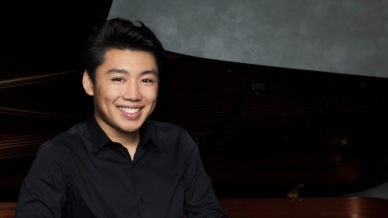
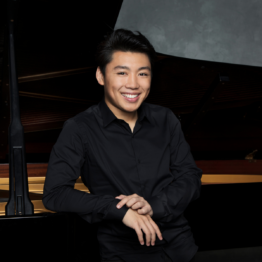
GEORGE LI piano

LIGETI Concert Românesc für Orchester
LISZT Piano Concerto No. 1 in E-flat Major for Piano and Orchestra
BARTÓK Concerto for Orchestra

Jamie Martin takes us on a tour of Hungarian music from the original rockstar, Franz Liszt, to the modern avant-garde genius of György Ligeti, whose 100th anniversary of his birth we celebrate in 2023.

Ligeti’s scores usually project a sensual appeal to which audiences overwhelmingly respond, even though its vocabulary is not that of most other music. Concert Românesc highlights the composer’s interest in the folk music he encountered as a child and later studied in great detail

George Li, an ultra-virtuosic pianist, takes center stage in the Liszt with blazing octaves, intricate ornamental figurations, and arpeggios running up and down the entire keyboard. The Washington Post said LI “combines staggering technical prowess, a sense of command and depth of expression.”

Then, Bartok allows each section of the orchestra to shine in his most popular orchestral work.

MORTON H. MEYERSON SYMPHONY CENTER
2301 Flora St.
Dallas, TX 75201

Jaime Martín, conductor

Jaime Martín

Conductor

Read More

George Li

Piano

Read More

ENRICO LOPEZ YAÑEZ conducts
AIDA CUEVAS

The GRAMMY® award-winning legend takes the stage at the Meyerson to showcase her remarkable imprint on the history of Mexican music. Cuevas is a master of the mariachi art song, setting her country-tinged rancheras to uplifting mariachi accompaniment. With a 42-year career and 39 album releases to her credit, Aida Cuevas has created one of the most important careers in traditional Mexican music.

Cherry Rhodes

Cherry Rhodes

Organ

Read More

FABIO LUISI conducts
HÉLÈNE GRIMAUD piano

BRAHMS Concerto No. 1 in D minor for Piano and Orchestra
FRANCK Symphony in D minor

Wildlife conservationist, activist, writer and virtuosic pianist, Hélène Grimaud returns to Dallas to perform Brahms’ First Piano Concerto, the composer’s first performed orchestral work. Grimaud’s thoughtful and tenderly expressive music making will ignite our emotions.

Following the Brahms, explore Franck’s Symphony in D minor. Cyclical and thematic, Franck’s symphony draws inspiration from Germanic musical tradition and Beethoven to form a creative and enthusiastic work. A popular piece in its day and considered to be French music’s most significant late-19th century symphony, the Franck is being reintroduced by conductors, like Fabio Luisi, with a passion for exposing lost masterpieces to new audiences.

FABIO LUISI MUSIC DIRECTOR LOUISE W. & EDMUND J. KAHN MUSIC DIRECTORSHIP

Fabio Luisi

Music Director

Louise W. & Edmund J. Kahn Music Directorship

Read More
Hélène Grimaud, Pianist

Hélène Grimaud

Piano

Read More

Program Notes

by René Spencer Saller

Brahms’s Piano Concerto No. 1 in D Minor is a radical, turbulent work with a long
and tortured gestation period. During the nearly five years that elapsed between the
preliminary sketches and the final revisions, Brahms was living out a soap opera. In
the winter of 1854, his cherished mentor Robert Schumann threw himself into the
Rhine and was sent to a sanatorium, where he would spend the rest of his life in
virtual exile, declining from delusional to nearly catatonic. Sadder still, his doctors
prohibited visits from his wife, Clara, a famous piano virtuosa and his greatest
champion, as well as the mother of their seven children.

As soon as he learned of Robert’s suicide attempt, Brahms rushed to the family’s aid,
living among them as man of the house. He and Clara became more than friends, if
not quite lovers. Although she was nearly 14 years his senior, Brahms wrote her
countless ardent letters. Yet when Robert died, in July 1856, Brahms did not ask
Clara to marry him and made it clear that he never would. She remained his beloved
muse, collaborator, and confidante, but he craved freedom. For the rest of his life, he
would have sex with prostitutes while carrying on intimate but platonic affairs with
the women he respected, admired, and loved.

Turmoil and Transformation
Before the First Piano Concerto was a concerto, it was a sonata for two pianos and
then a symphony. Brahms, an inexperienced orchestrator in his early 20s, became
blocked and put the project aside for two years, until Robert’s death compelled him
to revisit it. He struggled with the score, now a piano concerto, for another three
years, scrapping most of his preliminary efforts but retaining the tumultuous
opening.

Even after all the angst surrounding the composition of the D Minor Concerto,
Brahms was feeling hopeful about its first performances. He was the soloist, and
rehearsals had gone splendidly. But after a coolly polite reception in Hanover, its
official premiere at the prestigious Leipzig Gewandhaus was an unqualified disaster.
He played well, but everyone, even the conductor, hated the music. Brahms tried to
take it in stride, writing to an old friend that “the failure has made no impression
whatever on me…. After all, I’m only experimenting and feeling my way as yet. But
the hissing was too much of a good thing, wasn’t it?”

Despite his attempt at humor, the failure did affect him. He continued to compose, in
his painstaking, self-critical way, but he waited another 15 years before he offered
the public another original work of similar ambition.

A Closer Listen
The first movement is in sonata form, but only to a point. There are wrenching
breaks, themes shoving each other aside in the harmonic welter. The first measures
are studded with “devilish” tritone intervals, shockingly dissonant to Brahms’s
contemporaries and still unsettling today. As Brahms biographer Jan Swafford
explained, “the beginning of the Concerto evoked the tragedy that preceded its
inspiration by a few days: Robert Schumann’s leap into the Rhine…. If the
vertiginous opening moments of the concerto are applied to the image of a
desperate man leaping into the water, they become almost cinematically, kinetically
apt.”

The serene and radiant Adagio originally bore a religious inscription, a benediction
from the Latin mass. Devotional in tone, the second movement is both an elegy for
Robert and a “tender portrait,” in Brahms’s own words, of Clara, whom he had once
described as “going to the concert hall like a priestess to the altar.”

The assertive, driving finale follows a traditional rondo form and seems particularly
indebted to Beethoven’s Piano Concerto No. 3 in C Minor.

César Franck’s Symphony in D minor displays the Belgian-born French composer’s
love for the organ tradition of his adopted country and the German Romanticism of
his musical idols, Beethoven, Liszt, and Wagner. Invoking the latter three influences
was an especially risky move in the wake of the Franco-Prussian war, when anti-
German sentiment in France was at a fever pitch. Thanks to this rotten
concatenation of timing, history, and luck, the Paris premiere was a flop. Franck died
before his fellow countrymen could overcome their German animus enough to
appreciate the D minor Symphony’s radical genius.

Late Masterpiece
As a composer, Franck was something of a late bloomer, although his life in music
began in early childhood. Franck’s domineering father pushed him into the role of
child prodigy on the piano-recital circuit, and Franck was relieved when he grew out
of that unwanted gig. Studious and introspective, he preferred poring over his
counterpoint exercises and playing the organ to competitive concertizing. After he
moved out of his parents’ home, in his early 20s, he supported himself by teaching
music.

A few years later, after his marriage, Franck became a church organist, a position he
retained for the rest of his life. Like Saint-Saëns and Messiaen, he recognized the
true value of this vocation. More than a steady income, it meant access to the finest,
state-of-the-art music technology. Think of the organ as an entire orchestra playable
by a single musician: what better tool for a symphonic composer in the pre-digital
era?

His Symphony in D minor—Franck’s sole contribution to the genre, aside from a
long-lost juvenile effort—is that rare thing: a late-life masterpiece. He was 66 when
he finished it, and he died a year later. Many music writers consider it the greatest
symphony composed in France during the latter part of the 19th century.

Organic Germanic
Although Franck didn’t include an organ in the score (as Saint-Saëns famously did in
his Third Symphony), the organ haunts the symphony regardless. It’s a sepulchral
presence that imbues the work with what its admirers call grandeur and its
detractors call stodginess. Over the years, Franck’s symphony has fallen in and out
of favor, which says more about the fickle tastemakers who police the canon than it
does about the quality of Franck’s music. Although the symphony is widely admired
today, its Germanic odor offended audiences at the 1889 Paris premiere. Maurice
Ravel panned the symphony’s orchestration, Charles Gounod called it
“incompetence pushed to dogmatic lengths,” and the capital’s leading conductor,
Charles Lamoreux, declined to perform the work until after Franck’s death.

A Closer Listen
The first bar contains the work’s master theme, a three-note pattern from which all
future melodic material is derived. This opening volley unapologetically celebrates
one German master in particular: Beethoven. For his central motif, Franck borrowed
a musical phrase from the fragmentary final movement of Beethoven’s last string
quartet. The phrase is known as “Muss es sein?” (“Must it be?) because Beethoven
wrote these words on the manuscript.

Asked what inspired him to compose the symphony, Franck replied that it was “just
music, nothing but pure music.” He did, however, apply the term “classical” to his
symphony as well as a few descriptive phrases to each movement. The first
movement, he said, was “energetic and warm.” He called his favorite movement, the
central Allegretto, “sweet and melancholy,” adding that it was inspired by a far-off
funeral procession. The brass-dominated, thematically recursive finale was, to his
ears, “radiant and quasi-luminous.”