Jon Cziner on the world premiere of his new Clarinet Concerto.
We caught up with Dallas-based composer Jon Cziner at his home studio to talk about his new Clarinet Concerto premiering November 20-22 with the Dallas Symphony Orchestra and Music Director Fabio Luisi.
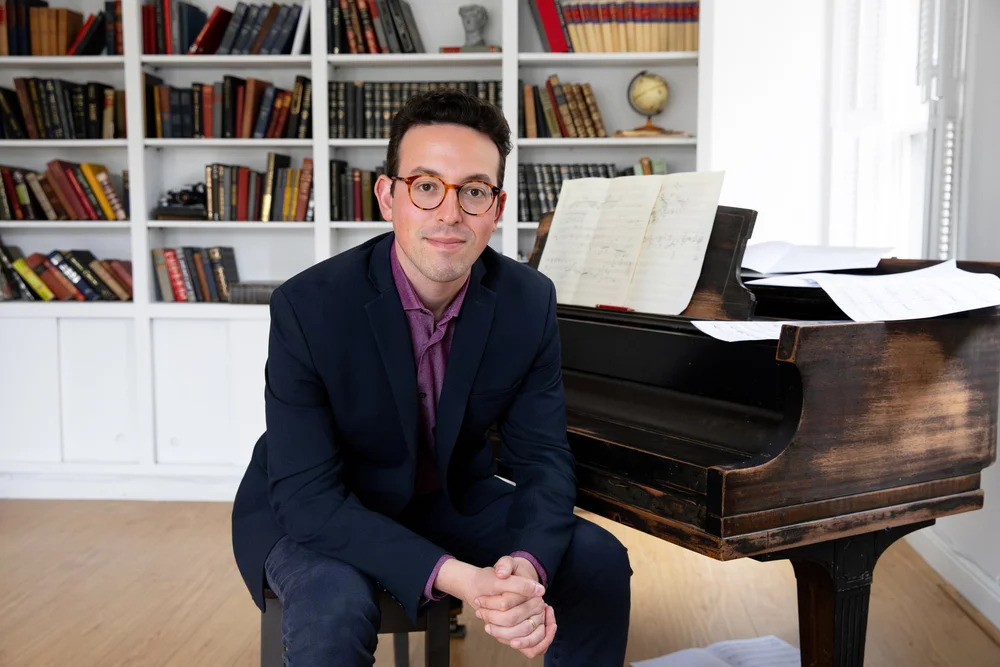
How would you describe your writing process? Would you say much of your writing process happens here in your home studio?
Absolutely! Everything happens in here. I usually start my day with a cup of coffee, relax for a little bit, and then try to set aside three to four hours of uninterrupted writing time. For me, I really like to start by sketching ideas out on paper, and then once something starts to take shape, I move to the computer. For big orchestral projects like this one, it’s easier for me to see everything or hear everything at once on a screen, rather than working from what we call a “short score,” which is only like three or four staves at a time.
How do these sketches evolve into the finished piece? Do you go from the beginning to the end, or do you jump around?
Every piece is different. I don’t compose every piece from beginning to end! For this work in particular, it was a little different because I had a piece that I wrote for Greg about five years ago for clarinet and string quartet. So in this case, I expanded and reworked that first movement, wrote new movements, and then made sure everything connected. I definitely have a sense of the overall structure before I start, which I think allows me to jump around a little bit throughout the process.
How would you describe the sound or style of this piece?
That’s always a hard question for composers! This piece is heavily influenced by Jewish music. That’s not the case for all my music, but I felt with a clarinet soloist, I had an opportunity to weave my everyday style with music that I think the clarinet does really well. You’ll hear klezmer elements, especially in the last movement, and a lot of cantorial influence in the first movement. In Jewish temples, we have a rabbi, and we have a cantor who leads the musical components of the service. The cantor sings these beautifully expressive, melismatic lines filled with both joy and longing. Growing up around that sound, it’s become a part of me, and naturally it found its way into the music.
Speaking of writing for the clarinet, did you listen to other clarinet concerti when writing the work?
Definitely! I think it’s really important for living composers to study the music of the past, from the ones that are highly regarded and well-known to some of those that aren’t. The Copland Concerto and the Nielsen Concerto were the biggest influences on this work. I heard Greg play the Copland years ago with the DSO, and that stuck with me. My piece follows the structure of the Copland in some ways. You’ll hear a slow first movement, a cadenza, and then a fast finale.
And what was the collaboration process like with Greg? Were you checking in with him throughout the writing process or sending him versions of the work?
For me, I really admire composers who check in with the performers they’re writing for, and that is something I try to do too. So, as much as I could, I would try to show him some of the music and if things needed to be tweaked to fit the instrument a little better, I could make those changes. What’s also special is that Greg and I grew up in neighboring towns in New York and are both from Jewish families. Now we’re both in Dallas, so this piece feels like a full-circle moment.
How does it feel to be contributing new repertoire for the clarinet?
It’s really exciting! Particularly for wind and brass instruments, there’s a dearth of repertoire, unlike many string instruments. So, if this piece can become something that other clarinetists take up, that’s a really meaningful outcome. With every new piece, there’s always a lot of hope that they have a life after their premiere.
How did you start composing?
I started with piano, but I didn’t really enjoy practicing much. That wasn’t my strength or my love, but I loved music! I’d sit at the piano and make things up instead. I would sort of improvise and play my own “stuff” on the piano, and by high school I really started taking composition more seriously. By the time I went to college, I began taking lessons, and I have to thank my teachers for really helping me develop my skills and craft as a young composer.
Were you from a musical family?
Not at all. A long line of doctors, teachers and medical professionals. I’m the only musician, which I think is a really cool thing because nobody else is doing that in my family, but it can also make it more challenging because I have to explain things a bit more. But I think that’s part of why I try to make new music feel more approachable. I think what a lot of composers are writing today – including myself, I hope – is accessible and fun to listen to. We’re writing at a time when the world is a troubled place, and I think it’s important to shed light on some of these things at times, but it’s also good to give the audience somewhere to go have a good time and enjoy themselves. Going back to the Clarinet Concerto, I think it does a bit of both.
You’re originally from New York but are now based in Dallas. Has living here shaped this piece?
Yes, in a way. In many ways I do feel at home here in Dallas, but I also miss the cultural fabric of New York, especially the Jewish presence that’s not a part of everyday life here. I would say that feeling of distance or homesickness shows up in the first two movements. The last movement, though, feels like a kind of reclaiming or a statement of pride in who I am and where I come from, no matter where I live.
You also lead Voices of Change, a Dallas-based group that celebrates and encourages new music. How does that fit into your creative life?
In many ways, it gives me a platform and an opportunity to kind of break down those barriers between living composers and Dallas audiences. I always tell people, just come to a concert. You might hear something beautiful or really fun or even something you may not have expected at all.
And finally, since you are local, any Dallas favorites? Or special interests or hobbies you’d like to share?
For favorite spots, I would say my wife Emily Levin (DSO Principal Harp) and I love White Rock Lake. We also frequent Cultivar, which is a great coffee shop in East Dallas inside Good Friend Package, which has great sandwiches and good people. As far as interests, I would say cooking, which is sort of another creative outlet in a way. I often will cook without a recipe, and I just like taking different ingredients I already have and just making something up. I think sometimes that can spur on some creative juices. No pun intended.