Remembering Morton H. Meyerson (1938-2025)
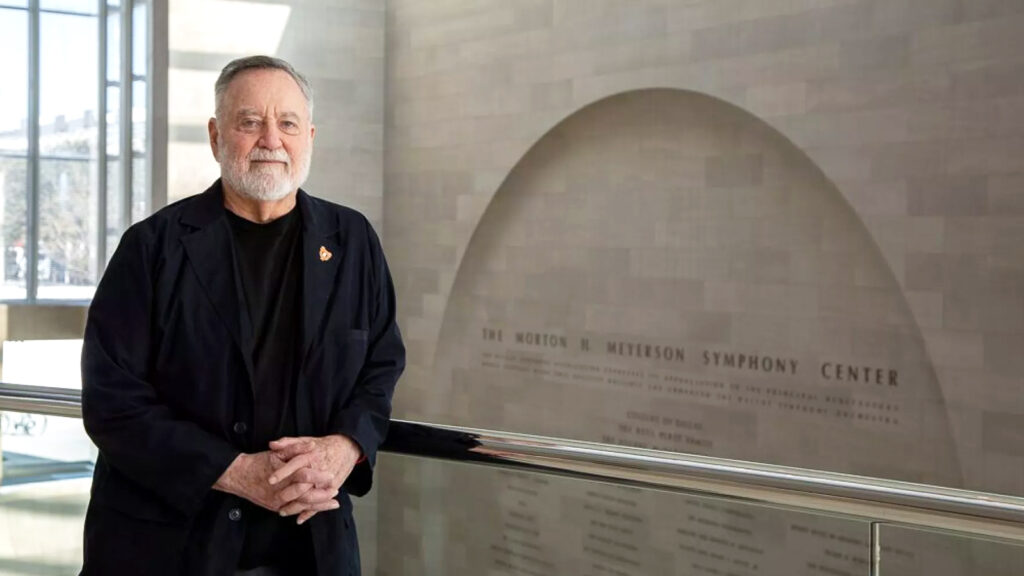
The Dallas Symphony Orchestra family mourns the loss of its dear friend and ardent champion Morton H. Meyerson. Our thoughts are with his family during this time.
Morton H. Meyerson was born in Fort Worth, Texas, to a family who loved music. His mother was a piano player and singer. Meyerson began singing at age three and started piano lessons at age four. At his alma mater, the University of Texas at Austin, he sang in the a cappella chorus. (His musical roots would appear again when he joined the Dallas Symphony Chorus for some of his favorite pieces including Carl Orff’s Carmina Burana and Mahler’s Symphony No. 2)
Meyerson’s service and volunteer leadership of the Dallas Symphony transformed the organization. He spent ten years spearheading the building of the DSO’s home that would bear his name, resulting in a concert hall that continues to awe and inspire. “The hall is the instrument,” Meyerson said in a 2018 interview with the DSO. “Given a great instrument, you have the possibility of having a great orchestra and a great symphonic community.”
Meyerson’s involvement with the DSO began in 1975 when Stanley Marcus asked the EDS executive for a donation from the company. Meyerson happily made the gift, and he was invited to join the board shortly after. “No one really knew my musical background,” he said, with a sly smile.
In 1979, then-DSO Board Chair Robert Dechard asked Meyerson to lead the building committee to erect a new concert hall for the Dallas Symphony Orchestra. “I said ‘you don’t want me because I’m not the right kind of person. I’m semi-bad-tempered. I have a short attention span. I’m very demanding. I’m not political, and I couldn’t fit in,’” said Meyerson. “Dechard responded, ‘We actually discussed that in the executive committee, and that’s the reason why we’re selecting you.’” Meyerson admitted he didn’t really know what he was getting into, but he said yes.
From that point and for ten years, Meyerson was committed to delivering an internationally renowned concert hall for the City of Dallas. His leadership of the building committee, and more importantly, what he referred to as the “Small Committee”, worked tirelessly and against many odds to erect the DSO’s home. This group hired architect I.M. Pei and acoustician Russell Johnson to lead their respective elements of the building, putting the two designers on separate contracts to ensure that the beauty of the building and the sound of the concert hall were equally considered. The result is timeless and one-of-a-kind architecture coupled with the warm, beautiful sound that envelops the audience inside the Eugene McDermott Concert Hall.
Morton H. Meyerson’s name welcomes thousands of visitors to his namesake symphony center, and it was his partnership with Ross Perot that made that happen. As the project was nearing the end, the budget needed $10 million to continue. Morton asked Perot for the gift, with the intention that the hall be named for the Perot family. Ross agreed, with one condition. It would be named for his friend who had given so much and led so beautifully for a decade. “Part of me is embarrassed. I came from a middle-class family in Fort Worth, and I am the grandson of immigrants. So I basically have lived the American Dream. Even in an American Dream, you don’t think that your name will be on a symphony hall. So for me it is slightly intimidating and slightly embarrassing. But it is not so embarrassing that I can’t take joy in it,” said Meyerson in an interview with KERA.

As the first notes rang out in September 1989, the raves were in. Optimism was high throughout the cultural community as this wonder of a building stood tall on Flora Street. Thirty-six years later, the raves continue. The Morton H. Meyerson Symphony Center is hailed as one of the “best-sounding concert halls in the world.” The Wall Street Journal has called it “sonically sumptuous”, and the local Dallas Morning News recently claimed, “I can’t think of another concert hall that puts orchestral sound so vividly in your face, so deep in your bones, with so rich and spacious an acoustical surround, as the Meyerson Symphony Center.”
Meyerson’s impact was felt far beyond the building of the hall. He was part of the team that searched for the DSO’s modern artistic leaders. Meyerson served on the search committees that identified and named Music Directors Andrew Litton and Jaap van Zweden. In 2017, he chaired the search committee that brought Fabio Luisi to Dallas. “It was clear to me after the first rehearsal that Fabio was the person who would take the DSO to the next level,” he said.
In 2024, the DSO performed Richard Wagner’s monumental Ring Cycle in its entirety. This was an historic event in the history of the organization and the first time in recent history that an American symphony had mounted such a production. It was a conversation between Meyerson and Luisi that started the process. Meyerson’s support of the operas-in-concert helped bring that incredible event to life on stage as well as support an upcoming commercial recording of the complete cycle.
“Mort often said he was not a musician, but his knowledge and judgment about music and musicians were some of the most profound and accurate I’ve known. My conversation with Mr. Meyerson that sparked the DSO’s recent Ring Cycle led to an event that will be forever remembered and treasured within the organization,” said Music Director Fabio Luisi. “Of course, this great hall that bears his name is our joy. Because he put architecture and acoustics on equal footing, the Meyerson Symphony Center is a concert hall that is celebrated worldwide for its beauty and warm, enveloping sound. We are grateful for his years of friendship and leadership for the DSO and for Dallas. The Dallas Symphony is so lucky to have had such a passionate supporter in Morton Meyerson.”
The etching in the stone above the entrance to the hall is a small monument to the impact and influence of this incredible man who gave of his time and resources to support and transform the organization. The DSO is eternally grateful for all he has done for the organization and what he has put in place for a bright future.