Rachmaninoff y Time for Three
2-4 de octubre de 2026
Meditaciones sobre el amor, la pérdida y nuestro profundo anhelo de conexión humana convergen en una velada de música conmovedora.
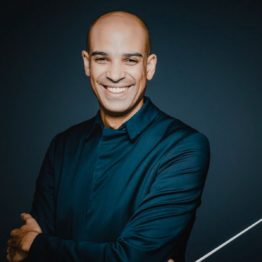
Kevin John Edusei Conduce
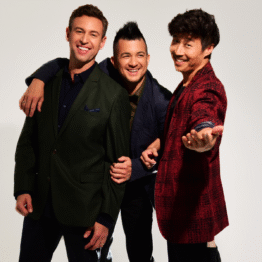
Nicolás “Nick” Kendall Violín
Charles Yang Violín
Ranaan Meyer Contrabajo
KEVIN PUTS Póngase en contacto con Triple Concierto (Estreno con la DSO)
RACHMANINOFF Sinfonía n.º 2 en mi menor
Marcado por las duras críticas tras el estreno de su Primera sinfonía, Rachmaninoff pensó que nunca volvería a componer otra. Pero tras una batalla de diez años contra la inseguridad, su siguiente sinfonía resultó ser un éxito rotundo, lo que demostró la resiliencia del compositor y su capacidad para conmover el corazón con una música de profunda belleza. Con su lirismo conmovedor y su sensualidad febril, la Sinfonía n.º 2 de Rachmaninoff abarca el amor y la pérdida, la pasión y la desesperación, al tiempo que ofrece algunas de las melodías más encantadoras jamás compuestas.
Pero primero, déjate sorprender por los músicos transgresores de Time for Three, que fusionan música clásica, bluegrass y canciones populares búlgaras en la obra de Kevin Puts.’ Póngase en contacto con. Ganador del Premio GRAMMY® 2023 a la Mejor Composición Clásica Contemporánea., Póngase en contacto con explora nuestro profundo anhelo de conexión humana.
Notas del programa
Written by René Spencer Saller
Performance History
Premiere Performance: March 26, 2022 | St. Petersburg, FL, USA
The Florida Orchestra; Time for Three, Trio | Daniel Black, Conductor
This is the DSO premiere.
Born in St. Louis, Missouri, where he began his piano lessons, Puts grew up in Alma, Michigan. (The family name is pronounced like the verb puts, as in “he puts his awards on the shelf.”) He attended Yale University and the Eastman School of Music, from which he earned a doctorate in musical arts, and he currently lives in Yonkers, New York, with his family. A member of the composition department faculty at the Peabody Institute, he directs the Minnesota Orchestra Composer Institute. His works have been commissioned, performed and recorded by many major orchestras and ensembles, including the St. Louis Symphony Orchestra, where he served as composer in residence during the 2025/26 season.
In 2024, América musical named Puts Composer of the Year, but his star had been rising for at least a decade by then. In 2012 his first opera, Noche de Paz, won the Pulitzer Prize. His fourth opera, an adaptation of Michael Cunningham’s novel Las horas, received its concert premiere in March 2022 and became an international hit as a fully staged Metropolitan Opera production later that year; the equally successful revival in May 2024 marked the first time in the institution’s history that a work was programmed the season after its premiere.
Composed for the uncategorizable trio Time for Three, the concerto Póngase en contacto con has been performed several times since its world premiere in March 2022, with the Florida Orchestra. Time for Three and the Philadelphia Orchestra, led by Xian Zhang, recorded the piece for the Deutsche Grammophon label as part of the album Cartas para el futuro, which won a GRAMMY® Award for Best Contemporary Classical Composition in 2023.
Habla el compositor
“In April 2017 I first heard a live performance by the prodigiously gifted string trio Time for Three at Joe’s Pub in New York City. The group — Nick Kendall and Charles Yang, violinists, and Ranaan Meyer, bassist — had reached out about the possibility of my writing them a concerto, and after hearing them play, sing, improvise and perform their own arrangements and compositions that evening I felt both elated — by the infectious energy and joy they exude as performers — and also rather daunted by the thought. It seemed our musical tastes were so similar that I suggested to them, not at all facetiously, ‘Maybe you ought to write your own concerto!’ I simply couldn’t imagine conceiving any music they couldn’t improvise themselves.
”One of the tunes the trio performed that night at Joe’s Pub was an original, called ‘Vertigo,’ which the guys later told me they wrote in a hotel room on the road. In the song, all three members both play their instruments and sing. I wondered about the possibility of beginning the concerto with the trio singing a wordless refrain, a capela. I wrote a chord progression which unfolds from a single note and progresses through simple, suspended harmonies. Orchestral winds respond with the same music while the trio adds decorative, improvisatory gestures. This idea, first heard in a reflective manner, grows considerably until the orchestral brass deliver a most emphatic version of it. This first movement (‘The Call’) ends with the same sense of questioning with which it began.
“Threatening unison stabs, played by the entire orchestra, break the mood startlingly and impel the soloists who drive forward with syncopated rhythms and virtuoso flurries of arpeggios. The energy in this second movement (‘Codes’) is unrelenting, often drawing its harmonic flavor from the ladder of notes which forms the overtone series and by combining triads from disparate keys.
“By yet another contrast, the orchestral music that opens the third movement (‘Contact’) is cold and stark. I had the image of an abandoned vessel floating inert in the recesses of space. The soloists interrupt this with a quiet, gently rolling meditation, eventually inviting a solo oboe and a solo clarinet to join in lyrical counterpoint high above. Eventually, the soloists recall the stark opening of the movement, rendering its rhythms into an unaccompanied phrase of tenderness and longing.
“To put it mildly, the search for a silver lining amid the Covid-19 pandemic was a unique challenge. But the cancellation of the initial performances of Póngase en contacto con scheduled for the summer of 2020 allowed us to continue working together on the concerto long after I finished it. Though my original title was simply Triple Concierto, we all agreed there was something more than abstract musical expression going on, that there was a story being told. Could the refrain at the opening of the concerto be a message sent into space, a call to intelligent life across the vast distances containing clues to our DNA, to our very nature as Earth people? Could the Morse code–like rhythms of the scherzo suggest radio transmissions, wave signals, etc.? And might the third movement (originally called simply ‘Ballad’) represent the moment of contact itself? (Admittedly, the climax of the film adaptation of Carl Sagan’s Póngase en contacto con, at which point Ellie, played by Jodie Foster, en route via a wormhole to an alien civilization, witnesses a radiant cosmic event to which she tearfully breathes, ‘No words…they should have sent a poet…no words….,’ was in my mind during these discussions.)
“Still in search of a finale to the concerto, I was serendipitously introduced to the wonderful gankino horo (Ganka’s Dance), a traditional Bulgarian melody, blazingly performed by at least 12 young cellists in unison at my (then) 10-year-old son Ben’s studio cello recital. At home, I began playing it on the piano and gradually my own compositional voice crept in. I was reminded of Bartok’s haunting Danzas populares rumanas and the composer’s fusion of his own musical sensibilities with age-old folk melodies. And so I set about composing a sort of fantasy on this tune, its asymmetric rhythmic qualities a fitting counterbalance to the previous three movements.
“The word contact has gained new resonance during these years of isolation. It is my hope that this concerto might be heard as an expression of yearning for this fundamental human need. I am deeply grateful to Time for Three for their belief in my work and for the tireless collaborative spirit which allowed us to develop this showcase for their immense talents.” — Kevin Puts (written on January 27, 2022)
Performance History
Premiere Performance: January 26, 1908 | Mariinsky Theatre; Saint Petersburg, Russia | Rachmaninoff, Conductor
Last DSO Performance: February 5, 2022 | Andrew Litton, Conductor
Born in Álamos, Sonora, Mexico, and now based in Mexico City, Márquez ranks among his country’s foremost living composers. His father was a violinist and mariachi musician; his mother was a singer; his paternal grandfather was a Mexican folk musician in Sonora and Chihuahua. Arturo was the firstborn of nine children and the only one to become a professional musician. When he was 12, his large family moved to La Puente, California, where the future composer benefited from the excellent band and vocal programs at his middle and high schools. He went on to study composition and piano at the National Conservatory of Music and the National Institute of Fine Arts in Mexico, supplementing his training with private lessons in France, and eventually completing a Master of Fine Arts degree at the California Institute of the Arts.
Márquez started composing in his mid-teens and began to attract serious notice in the 1980s. The recipient of many international awards and honors, including a Fulbright Scholarship, he is particularly popular in Latin America, where music festivals are named in his honor. In the United States he is best known for his Danzones, which pay loving tribute to the distinctive dance forms and styles of the Veracruz region of Mexico. Several are popular choices among choreographers and band leaders.
Márquez wrote his Concierto Mistico y Profano (Mystical and Profane Concerto) in 2025 for the Spanish guitarist Pablo Sainz-Villegas, one of the composer’s most eloquent advocates and the work’s dedicatee. In an online interview with the Orquesta Sinfónica de Minería published before the July 5 world premiere, Sainz-Villegas, who collaborated closely with Márquez, predicted that the debut performance, at the Sala Nezahualcóyotl in Mexico City, under Carlos Miguel Prieto’s baton, would “go down in history.” Márquez, he explained, “explores the dualities of the human soul with moving depth. And to do so he also explores the expressive limits of the guitar with great sensitivity.”
In the same interview Sainz-Villegas recalled that while discussing the orchestration the two men revisited several examples from the repertoire, spanning the famous and the all but forgotten: “I would say that Márquez’s orchestration is very careful, very colorful, very pointillist. He also achieves an extraordinary thing: that after listening to this music, the listener returns home humming it.”
Una escucha más atenta
Cast in the conventional three movements, the concerto brings folk and popular music styles from Mexico, Spain, and points beyond into forms and genres long associated with the more Eurocentric concert music tradition, which is to say what most people mean when they say “classical music” and aren’t referring to the specific historical period. The point ought to be moot by now anyway. From Gershwin to Copland to Márquez, the composer is a natural syncretist, someone who scoffs at snobs and nativists, someone who loves radically. Sound knows no borders.
Sainz-Villegas describes the first movement, Encuentro (Encounter), as “two cultures shak[ing] hands through this concerto. Celebrating the peoples and the concord between peoples. Music as an expression of union. Transcending dualisms.”
Structurally, it combines a pair of contrasting themes: a passionate and dramatic idea that involves “a lot of strumming” and a gentler, more bittersweet melody that the guitarist compares to a “caress.”
The central Serenata Piadosa (Pious Serenade) showcases a luminous solo clarinet, one of Marquez’s favorite instruments and a natural timbral ally of the guitar. “When the clarinet enters, in the second movement, you are floating,” Sainz-Villegas notes. He calls the overall movement “a wonderful prayer of a mystical depth that takes you to places of introspection.”
The celebratory finale, Diferencias sobre la Romanesca (Variations on the Romanesca), uses a 16th-century Spanish dance form in triple meter as the foundation for a set of colorful and often virtuosic variations.