Scheherazade y Pablo Sainz-Villegas
24-27 de septiembre de 2026
Desde la antigua Persia hasta México y las praderas de Argentina, embárcate en una aventura alrededor del mundo con los brillantes colores de la orquesta.
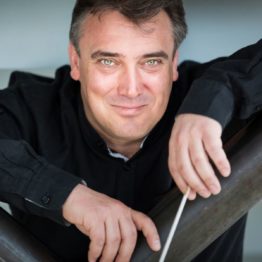
Jaime Martín Conduce
Pablo Sainz-Villegas Guitarra
GINASTERA Cuatro danzas de Estancia
ARTURO MÁRQUEZ Concierto Místico y Profano (Estreno en la DSO)
RIMSKY-KORSAKOV Scheherazade
Viaje al mundo de cuento de hadas de Las mil y una noches en la cinematográfica de Rimsky-Korsakov Scheherazade. Historias vertiginosas de amor juvenil y emocionantes aventuras en el mar con brillantes colores orquestales., Scheherazade evoca a la legendaria reina persa que logró aplazar su propia ejecución gracias a 1.001 noches de fascinantes relatos.
En Místico y Profano (Místico y profano), Arturo Márquez fusiona las tradiciones musicales de México y España en una celebración intercultural para guitarra y orquesta. Pablo Sainz-Villegas, “el embajador mundial de la guitarra española” (Cartelera), se une a la DSO para crear un tapiz musical de bailes apasionados, ritmos ardientes y oraciones íntimas.
Opening this program conducted by Jaime Martín, Ginastera’s Four Dances from Estancia da vida a las exuberantes praderas de la Argentina. pampa, donde vaqueros y ganaderos se enfrentan en una espectacular competición de baile.
Notas del programa
Written by René Spencer Saller
Performance History
Premiere Performance: 1943 | Buenos Aires, Argentina
Teaotro Coloacuten
Last DSO Performance: June 7, 2022 | Maurice Cohn, Conductor
Born in Buenos Aires to a Spanish father and an Italian mother, Ginastera (he pronounced it the Catalan way: JEE-nah-STAIR-uh) began his conservatory training at age 12. In 1942 he won a Guggenheim Foundation grant, which he used a few years later to study with Aaron Copland in the United States.
Idealistic and outspoken, Ginastera made many political enemies in his native Argentina. In 1952 he lost his position at Argentina’s leading music conservatory, Conservatorio de Música y Arte Escénico in La Plata, which he had founded and directed since 1948. He offended the all-powerful Peróns by refusing to rename the conservatory after Eva, the president’s wife. Deprived of his academic post (at least until Juan Perón was deposed in a military coup), Ginastera survived by scoring films and accepting random commissions. He spent the last dozen years of his life in Geneva, Switzerland, where he died of cancer.
A meticulous craftsman, Ginastera routinely destroyed any efforts that he deemed unsatisfactory — and he was seldom satisfied. What passed through his filter was pure gold. Although he left only 54 numbered opuses, most remain in the active repertoire.
Late in life, Ginastera categorized his works into three general periods, which he helpfully identified as objective nationalist (1934–1948), subjective nationalist (1948–1958), and neo-expressionist (1958–1983). Estancia, completed in 1941, was commissioned by Lincoln Kirstein for the American Ballet Caravan. The title refers to a cattle ranch on the vast pampas (grassy plains) of the South American lowlands, where the guitar-wielding, quick-stepping gaucho of Argentine folk-legend evolved. After the ballet production was delayed, Ginastera prepared a concert suite, Opus 8a, which received its premiere in 1943, in Buenos Aires.
Una escucha más atenta
El Estancia suite comprises four parts. First, Ginastera offers a “morning section,” Los trabajadores agricolas (Agricultural workers), based on a fast and macho competitive folk dance, the malambo (meant for gaucho dancers — tap-dancing Argentine cowboys). Next, the mellow Danza del trigo (Wheat Dance) offers lyrical flute melodies and lustrous violins. Los peones de hacienda (The Cattlemen) is rhythmically volatile, spiked with syncopated brass and timpani. Danza final (Final Dance) reprises the malambo for a final showdown among the gauchos.
From the composer’s preface to the published score: “The deep and bare beauty of the land, its richness and natural strength, constitutes the basis of Argentine life. This ballet presents various daily aspects of the activities of an estancia, from dawn to dusk, with a symbolic sense of continuity. The plot of the ballet shows a country girl who at first despises the man of the city. She finally admires him when he proves that he can perform the most rough and difficult tasks of the country.”
Performance History
Premiere Performance: July 5, 2025 | Mexico City, Mexico
Orquesta Sinfónica de Minería
Carlos Migues Prieto, Conductor
Pablo Sainz Villegas, Guitar
This is a DSO premiere.
Born in Álamos, Sonora, Mexico, and now based in Mexico City, Márquez ranks among his country’s foremost living composers. His father was a violinist and mariachi musician; his mother was a singer; his paternal grandfather was a Mexican folk musician in Sonora and Chihuahua. Arturo was the firstborn of nine children and the only one to become a professional musician. When he was 12, his large family moved to La Puente, California, where the future composer benefited from the excellent band and vocal programs at his middle and high schools. He went on to study composition and piano at the National Conservatory of Music and the National Institute of Fine Arts in Mexico, supplementing his training with private lessons in France, and eventually completing a Master of Fine Arts degree at the California Institute of the Arts.
Márquez started composing in his mid-teens and began to attract serious notice in the 1980s. The recipient of many international awards and honors, including a Fulbright Scholarship, he is particularly popular in Latin America, where music festivals are named in his honor. In the United States he is best known for his Danzones, which pay loving tribute to the distinctive dance forms and styles of the Veracruz region of Mexico. Several are popular choices among choreographers and band leaders.
Márquez wrote his Concierto Mistico y Profano (Mystical and Profane Concerto) in 2025 for the Spanish guitarist Pablo Sainz-Villegas, one of the composer’s most eloquent advocates and the work’s dedicatee. In an online interview with the Orquesta Sinfónica de Minería published before the July 5 world premiere, Sainz-Villegas, who collaborated closely with Márquez, predicted that the debut performance, at the Sala Nezahualcóyotl in Mexico City, under Carlos Miguel Prieto’s baton, would “go down in history.” Márquez, he explained, “explores the dualities of the human soul with moving depth. And to do so he also explores the expressive limits of the guitar with great sensitivity.”
In the same interview Sainz-Villegas recalled that while discussing the orchestration the two men revisited several examples from the repertoire, spanning the famous and the all but forgotten: “I would say that Márquez’s orchestration is very careful, very colorful, very pointillist. He also achieves an extraordinary thing: that after listening to this music, the listener returns home humming it.”
Una escucha más atenta
Cast in the conventional three movements, the concerto brings folk and popular music styles from Mexico, Spain, and points beyond into forms and genres long associated with the more Eurocentric concert music tradition, which is to say what most people mean when they say “classical music” and aren’t referring to the specific historical period. The point ought to be moot by now anyway. From Gershwin to Copland to Márquez, the composer is a natural syncretist, someone who scoffs at snobs and nativists, someone who loves radically. Sound knows no borders.
Sainz-Villegas describes the first movement, Encuentro (Encounter), as “two cultures shak[ing] hands through this concerto. Celebrating the peoples and the concord between peoples. Music as an expression of union. Transcending dualisms.”
Structurally, it combines a pair of contrasting themes: a passionate and dramatic idea that involves “a lot of strumming” and a gentler, more bittersweet melody that the guitarist compares to a “caress.”
The central Serenata Piadosa (Pious Serenade) showcases a luminous solo clarinet, one of Marquez’s favorite instruments and a natural timbral ally of the guitar. “When the clarinet enters, in the second movement, you are floating,” Sainz-Villegas notes. He calls the overall movement “a wonderful prayer of a mystical depth that takes you to places of introspection.”
The celebratory finale, Diferencias sobre la Romanesca (Variations on the Romanesca), uses a 16th-century Spanish dance form in triple meter as the foundation for a set of colorful and often virtuosic variations.
Performance History
Premiere Performance: October 28, 1888 | St. Petersburg, Russia
Rimsky-Korsakov, Conductor
Last DSO Performance: February 25, 2023 | Marin Alsop, Conductor
“We tell ourselves stories in order to live,” Joan Didion famously observed. In Scheherazade’s case, the maxim is literal: her survival depends on a gift for the gab. The stories she uses to captivate her murderous sultan-spouse aren’t her own inventions, but they don’t need to be. Her voice compels. It keeps her alive in the story, in every possible sense.
Rimsky-Korsakov based his 1888 symphonic suite Scheherazade on a translation of The Thousand and One Nights, a collection of tales so ancient they might as well be encoded in our DNA. He named the work for the heroine whose dilemma frames the tales: Scheherazade, who keeps herself safe from her homicidal husband by hooking him on her fiction. After each new cliffhanger, the story-loving sultan postpones her execution, night after night, until he finally decides to spare her.
Aunque Rimsky-Korsakov reconoció que Scheherazade consistía en "episodios e imágenes separadas e inconexas de Las mil y una noches,” with a unifying theme representing Scheherazade herself, he tried not to get bogged down in too much extramusical detail. In his memoir he described his artistic goals: “All I had desired was that the listener, if he liked my piece as symphonic music, should carry away the impression that it is beyond doubt an Oriental narrative of some numerous and varied fairy-tale marvels and not merely four pieces played one after another and composed on the basis of themes common to all four movements.”
Una escucha más atenta
Rimsky-Korsakov’s descriptive titles refer to famous scenes in the collection, not to specific stories. The opening movement, “The Sea and Sinbad’s Ship,” juxtaposes a harsh, articulated theme, which may represent the Sultan or possibly Sinbad, and a sinuous legato motif, sung by solo violin, that suggests the beguiling voice of Scheherazade herself.
The concerto-like second movement, “The Story of the Kalender Prince,” highlights various solo instruments and instrumental groupings as it enacts the many transformations of a masquerading prince. “The Prince and the Princess” is a rapturous romp that wouldn’t sound out of place on the soundtrack of a late-1940s Hollywood melodrama.
The finale contains three parts: “Festival at Baghdad,” “The Sea” and “The Ship Is Dashed Against a Rock Surmounted by a Bronze Warrior.” Like the first movement, it opens with dramatic elaborations of the contrasting Sultan and Scheherazade themes. The mood is lively, almost manic in its profuse variations. Strings scurry, brass stutters and as the hysteria mounts, in come the lordly trombones intoning their grim message against a maelstrom of strings, winds and percussion. An even more ominous passage ensues, pierced by the doomy clash of a gong. Then, accompanied by gentle winds and delicate harp, Scheherazade sashays back with an acutely seductive take on her by now familiar violin theme. She has saved her own life and maybe the soul of a despot, too. As the suite closes, the violin holds one long, impossibly sweet and sustaining high note.